D2C Marketing Strategy for a New Indian Brand
A practical D2C marketing strategy for new Indian brands: unit economics, Meta and Google ad mix, WhatsApp marketing, COD management, and retention.
By IPrix Media Team, digital marketing agency in Udaipur
Launching a direct-to-consumer (D2C) brand in India is an exciting venture, but the digital landscape has shifted dramatically over the past two years. Gone are the days when a new brand could simply set up a basic online store, run low-cost Facebook ads, and generate immediate profits. Today, rising Customer Acquisition Costs (CAC) across Meta and Google, combined with fierce competition from established marketplace sellers and heavy Cash on Delivery (COD) return rates, make undisciplined marketing campaigns a fast path to burning cash.
To build a sustainable and profitable online brand in India, founders must transition from vanity metrics—such as cheap website clicks and social media followers—to disciplined unit economics, multi-channel customer acquisition, and aggressive repeat purchase loops. This comprehensive guide outlines a tested D2C marketing playbook engineered specifically for early-stage Indian brands seeking consistent sales growth while protecting contribution margins.
1. Master Your Unit Economics Before Spending on Paid Ads
The single biggest reason early-stage Indian D2C brands fail within six months is ignoring unit economics. If your product margins cannot absorb real-world digital marketing costs, shipping expenses, gateway fees, and packaging overhead, scaling your ad spend will only accelerate your losses.
Before launching marketing campaigns, calculate your Contribution Margin 1 (CM1) per order using this breakdown:
| Cost Component | Realistic Range (% of Order Value) | Operational Impact on Indian Brands |
|---|---|---|
| Cost of Goods Sold (COGS) | 20% to 30% | Product manufacturing, formulation, and primary packaging. |
| Payment Gateway Charges | 2% to 2.5% | Domestic payment processing fees (Razorpay / Cashfree + GST). |
| Shipping & Courier Overhead | 8% to 15% | Forward delivery fee (Shiprocket/Delhivery) based on parcel weight. |
| RTO & Damage Allowance | 5% to 10% | Courier cost loss on unaccepted COD orders and transit damages. |
| Pick & Pack Warehouse Cost | 3% to 5% | Outer corrugated box, thermal labels, and warehouse staff. |
| Maximum Allowable Blended CAC | 30% to 40% | Total marketing budget available to acquire each new paying customer. |
| Target Contribution Profit | 15% to 20% | Net profit remaining before company fixed overheads and salaries. |
As a general rule, if your average selling price is below ₹799, direct digital ad acquisition is extremely difficult to sustain in India because courier and ad platform delivery costs remain constant regardless of order value. Brands with products below this threshold should bundle products into kits or create minimum order thresholds to lift their Average Order Value (AOV) above ₹1,200.
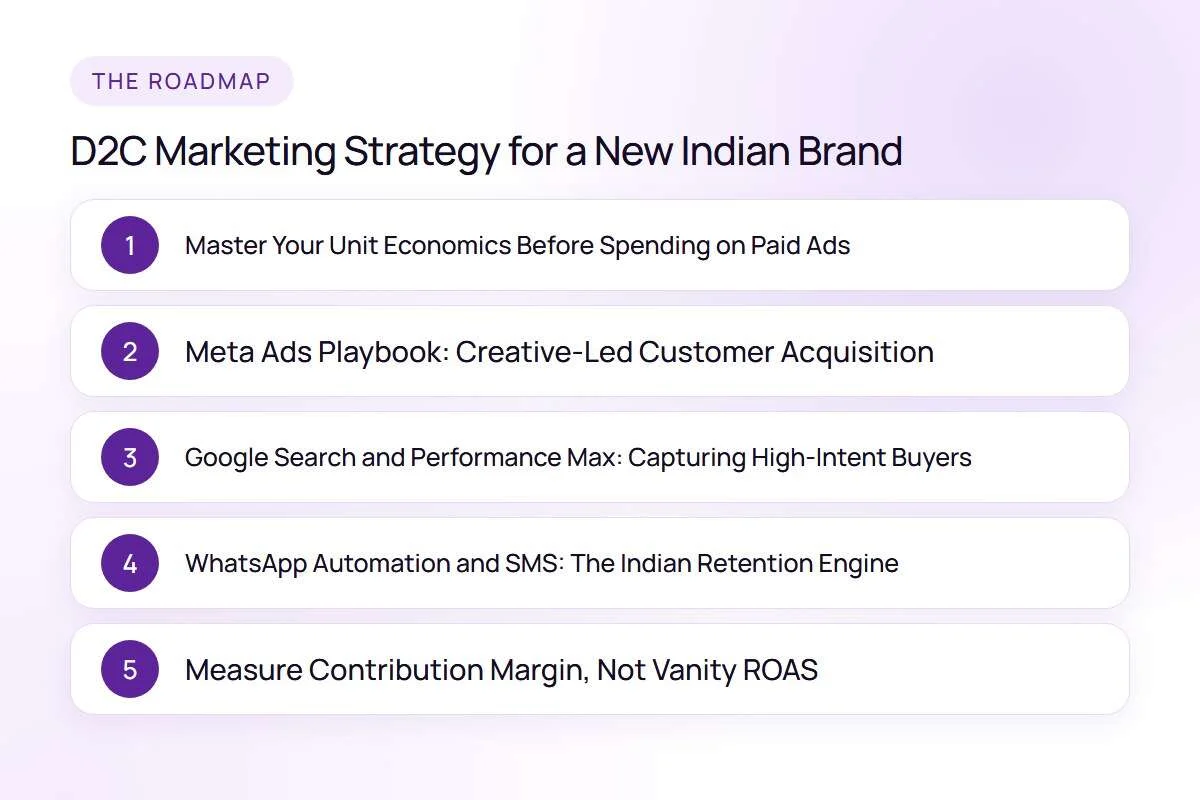
2. Meta Ads Playbook: Creative-Led Customer Acquisition
Meta (Instagram and Facebook) remains the primary demand-generation engine for Indian consumer brands. However, relying on complex audience interest targeting or hundreds of micro-targeted ad sets no longer works. Meta's modern delivery algorithm uses machine learning to find prospective buyers based entirely on the creative format, audio hook, and visual message of your ad.
To scale paid customer acquisition profitably:
- Prioritise Short-Form Video (Reels): Produce authentic, direct-to-camera videos showing product unboxing, immediate problem demonstration, texture or quality close-ups, and clear customer reviews. Polished, corporate studio ads routinely underperform authentic customer-style creative by fifty percent.
- Hook Buyers in the First 3 Seconds: Address the customer's exact pain point or curiosity trigger immediately. If a viewer cannot understand what problem your product solves within three seconds, they will swipe to the next video.
- Consolidate Ad Campaigns: Avoid fragmenting your budget across twenty different ad sets. Use a simplified Broad Targeting campaign structure, allowing Meta's algorithm to optimise delivery across pan-India audiences.
- Test 3 to 5 New Creative Variations Weekly: Creative fatigue sets in quickly in competitive consumer niches. Maintain a continuous pipeline of new hooks, static comparison graphics, and customer testimonials.
For businesses seeking end-to-end performance marketing management, explore our dedicated ecommerce marketing agency services.
3. Google Search and Performance Max: Capturing High-Intent Buyers
While Meta creates awareness and desire, Google captures buyers who are actively searching for solutions. When a consumer has already decided to purchase, they turn to Google Search and Google Shopping.
Your Google Ads strategy should combine two primary campaign types:
- Google Performance Max (PMax): Connect your verified Google Merchant Center product feed to display visual shopping ads across Google Search, YouTube, Gmail, and Google Discover. Ensure your product titles include primary search keywords, specifications, and sizes.
- High-Intent Search Campaigns: Bid on exact problem-solving keywords (such as "natural ayurvedic hair oil for hair fall" or "anti-spill stainless steel dog bowl"). Avoid broad generic keywords like "shoes" or "fashion", which consume budget without generating conversions.
- Branded Search Protection: Once your Meta ads begin driving brand recognition, run a dedicated, low-cost search campaign on your own brand name. This prevents competitors and third-party discount aggregators from hijacking your branded search traffic.
4. WhatsApp Automation and SMS: The Indian Retention Engine
In the Western market, email marketing drives up to thirty percent of e-commerce revenue. In India, while email remains important for transaction receipts and corporate communication, average consumer email open rates hover below ten percent. Conversely, WhatsApp open rates in India exceed ninety percent, making automated WhatsApp marketing your most powerful tool for recovering abandoned shopping carts and driving repeat orders.
Implement these four automated WhatsApp flows through an official WhatsApp Business API provider:
- Abandoned Cart Recovery Flow: Trigger an automated reminder 30 minutes after cart abandonment showing the exact product image, followed by a time-sensitive incentive (such as free shipping or a 5% prepaid discount) after 4 hours. This recovers 15% to 25% of abandoned checkouts.
- COD Confirmation and Address Cleanup: Instantly message COD buyers asking them to click a one-tap button to confirm their delivery address, significantly reducing fake orders.
- Post-Delivery Feedback and Care Guide: Send helpful tips on how to use the product 24 hours after courier delivery. Delighted customers are far more likely to leave positive reviews and make repeat purchases.
- Replenishment and Cross-Sell Triggers: For consumable goods (skincare, food, supplements, pet supplies), calculate the typical usage cycle and trigger an automated re-order reminder 5 to 7 days before the product runs out.
If your technical infrastructure requires custom automated funnels, our developers build robust backend integrations through our ecommerce website development division.
5. Measure Contribution Margin, Not Vanity ROAS
Many founders celebrate an apparent 4x Return on Ad Spend (ROAS) on their ad dashboard, only to discover at month's end that their bank balance has decreased. Advertising platform dashboards rely on attribution models that frequently take credit for organic or returning buyers, and they ignore returns, cancelled COD parcels, and gateway transaction charges.
To manage your growth with true financial discipline:
- Track Blended Marketing Efficiency Ratio (MER): Calculate total website revenue divided by total digital ad spend across all channels. A healthy blended MER for an early-stage D2C brand typically ranges from 3.0 to 4.5.
- Monitor Net Delivered ROAS: Deduct RTO returns and customer cancellations from your revenue before evaluating campaign profitability.
- Prioritise 60-Day Repeat Purchase Rates: A healthy direct-to-consumer brand should see at least 20% to 30% of its customers return to make a second purchase within sixty days. First-order acquisition often breaks even; real operational profit is made on customer retention where CAC is zero.
FAQs
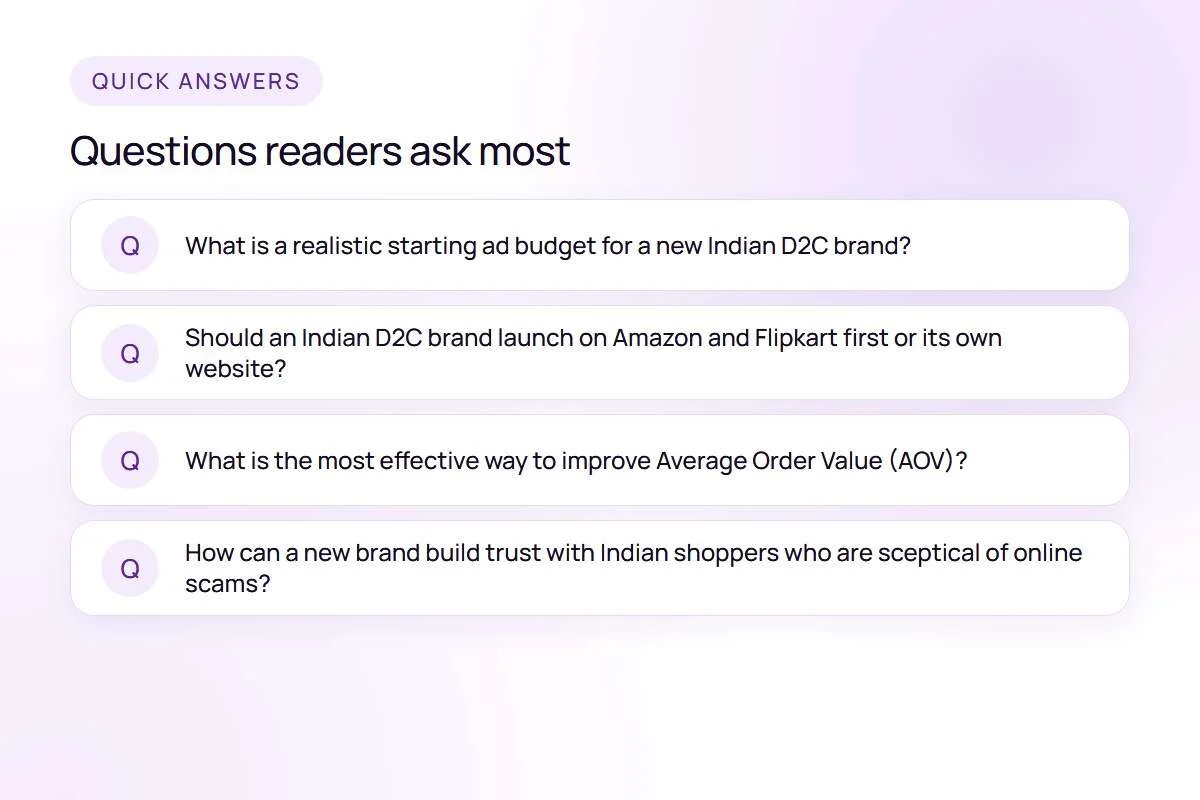
What is a realistic starting ad budget for a new Indian D2C brand?
A practical starting budget for testing product-market fit and creative messaging is ₹30,000 to ₹50,000 per month. This provides sufficient conversion data across Meta and Google without burning excessive capital while refining your checkout journey.
Should an Indian D2C brand launch on Amazon and Flipkart first or its own website?
Both channels serve complementary purposes. Marketplaces offer immediate built-in consumer traffic, but they keep customer data and enforce high commission fees (15% to 35%). Running your own D2C website gives you full customer ownership, direct WhatsApp communication, higher brand equity, and the ability to build long-term enterprise valuation.
What is the most effective way to improve Average Order Value (AOV)?
Create multi-product bundles, tiered discounts (such as "Buy 2 Get 10% Off"), and post-purchase one-click upsells. Increasing your AOV from ₹800 to ₹1,400 dramatically improves contribution margins because courier shipping fees increase only marginally.
How can a new brand build trust with Indian shoppers who are sceptical of online scams?
Display verified customer reviews with real user photographs, prominently feature your GSTIN and physical business address, partner with recognised payment providers like Razorpay, and offer clear COD with easy exchange policies.
Next Steps for Your D2C Brand
Building a profitable D2C brand in India requires combining creative storytelling with rigorous mathematical discipline. By tracking contribution margins, producing creative-first short-form video ads, automating WhatsApp retention loops, and controlling courier delivery costs, you create a sustainable business model capable of scaling into an industry leader.
If your brand is ready to scale its online revenue through performance marketing and high-converting e-commerce engineering, explore our specialised ecommerce marketing agency services or consult with our growth strategists at IPrix Media today.