Google Ads vs Meta Ads: Which Is Better for Your Business?
Google Ads captures existing demand, Meta Ads creates it. Compare intent, cost, targeting and creative needs to decide where to invest first.
By IPrix Media Team, digital marketing agency in Udaipur
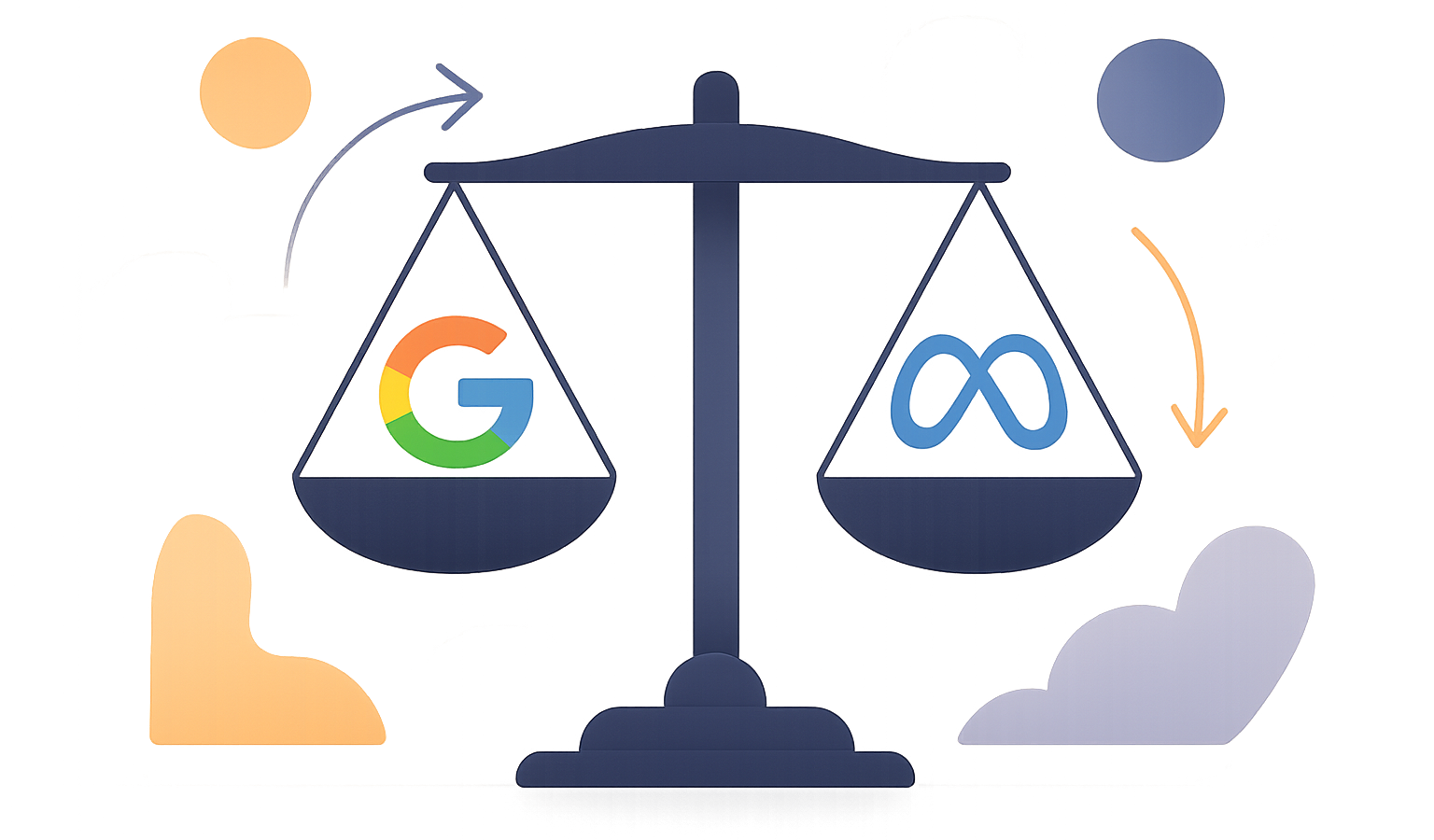
Google Ads captures people who are already searching for what you sell, while Meta Ads (Facebook and Instagram) creates demand by showing your offer to people who match your ideal customer. Neither is universally better. The right choice depends on your product, margin and stage.
Quick comparison
- Intent: Google is high intent (search). Meta is discovery-led (scroll).
- Best for: Google suits services, urgent needs and known categories. Meta suits visual, impulse and emerging products.
- Creative demand: Google relies on keywords and copy. Meta relies heavily on video and imagery.
- Scale: Google is limited by search volume. Meta scales with audience size and creative volume.
- Funnel role: Google often closes. Meta often opens and retargets.
When to start with Google Ads
Choose Google first if people actively search for your solution: plumbers, dentists, B2B software, local services, high-consideration purchases. Search ads reach buyers at the moment of need, which usually means higher conversion rates and faster payback.
When to start with Meta Ads
Choose Meta first if your product is visual or new, such as fashion, jewellery, beauty, home goods or lifestyle brands, where few people search for you by name yet. Meta lets you build demand and retarget visitors cheaply.
Why most growing brands use both
Meta builds awareness and fills the top of the funnel. Google captures the branded and category searches that awareness creates. Retargeting on both platforms brings back visitors who did not convert the first time. Together they lift total conversions and often lower blended acquisition cost.
How to decide your budget split
- Start with your break-even CPA or ROAS.
- Test each platform with a controlled budget for three to four weeks.
- Shift spend toward the channel with the better marginal return, keeping a share for retargeting.
- Review blended revenue against total ad spend every week.
Common mistakes
- Judging Meta by last-click only, which undervalues its assistive role.
- Running Google Search without negative keywords and conversion tracking.
- Sending both to a slow, generic homepage instead of a focused landing page.
Get a clear plan
Our ROI-focused Google and Meta ads service builds a channel mix around your numbers. Talk to us for a free account review.
Understanding Audience Targeting
Audience targeting plays a crucial role in determining the effectiveness of your ad campaigns. Both Google Ads and Meta Ads offer distinct targeting options, catering to different marketing strategies.
Google Ads Targeting
Google Ads primarily focuses on intent-based targeting. It allows advertisers to target users based on keywords, location, language, device, and even time of day. This is particularly beneficial for businesses aiming to capture potential customers at the exact moment they are searching for a solution.
- Use keyword planning tools to identify high-intent search terms.
- Leverage location targeting for local businesses.
- Optimize bids for mobile devices if your audience is mobile-centric.
Meta Ads Targeting
Meta Ads, on the other hand, excel in demographic, interest, and behavior-based targeting. This platform enables advertisers to reach users based on their interests, behaviors, and demographics, making it ideal for brand awareness campaigns.
- Utilize custom audiences to retarget website visitors or app users.
- Experiment with lookalike audiences to expand reach.
- Test different demographics to find your ideal customer profile.
Effective audience targeting requires a deep understanding of your target market. Regularly analyze campaign data to refine your targeting strategy and improve results.
Crafting Compelling Ad Creatives
The success of your ad campaigns largely depends on the quality of your ad creatives. Both platforms require different approaches to ad creation.
Google Ads Creatives
Google Ads relies heavily on text-based ads, which means your copy must be precise and compelling. Ad extensions can enhance your ads by providing additional information, such as contact details or links to specific pages.
- Write clear, concise headlines that highlight your unique selling proposition (USP).
- Include a strong call-to-action (CTA) to encourage clicks.
- Use ad extensions to provide additional value.
Meta Ads Creatives
Meta Ads thrive on visual appeal. High-quality images and videos are essential to capture users’ attention as they scroll through their feeds. Creative storytelling and engaging visuals can significantly boost your ad performance.
- Invest in high-quality images and video production.
- Test different ad formats, such as carousel or video ads, to see what resonates.
- Ensure your visuals align with your brand identity and message.
Regularly updating and testing ad creatives can help maintain user interest and improve your campaign’s overall effectiveness.
Analyzing Performance Metrics
Understanding and analyzing performance metrics is key to optimizing your ad campaigns. Both Google Ads and Meta Ads offer robust analytics tools to track and measure campaign success.
Google Ads Metrics
Google Ads provides detailed metrics, including click-through rate (CTR), cost per click (CPC), conversion rate, and return on ad spend (ROAS). These metrics help you understand how your ads are performing and where adjustments may be needed.
- Monitor CTR to gauge ad relevance and engagement.
- Track conversion rates to assess the effectiveness of your landing pages.
- Calculate ROAS to determine the profitability of your campaigns.
Meta Ads Metrics
Meta Ads offer insights such as engagement rate, reach, and impressions. These metrics can help you understand how your audience is interacting with your ads and how far your ads are reaching.
- Analyze engagement rate to measure user interaction with your ads.
- Check the reach and impressions to evaluate the breadth of your campaign.
- Use A/B testing to refine your ad creatives and targeting.
Regularly reviewing and interpreting these metrics will enable you to make data-driven decisions and improve your ad campaign performance.
Understanding Cost Structures
Understanding the cost structures of Google Ads and Meta Ads is essential for budgeting and maximizing your return on investment (ROI).
Google Ads Costs
Google Ads operates on a pay-per-click (PPC) model, meaning you pay each time someone clicks on your ad. The cost per click varies based on competition, keyword relevance, and quality score. It’s crucial to manage your bids and budget effectively to ensure a profitable campaign.
- Set a daily budget to control ad spend.
- Utilize bid adjustments for specific times or devices.
- Focus on high-performing keywords to maximize ROI.
Meta Ads Costs
Meta Ads use a cost-per-impression (CPM) or cost-per-click (CPC) model. The platform offers flexible budgeting options, allowing you to set a daily or lifetime budget. Understanding the bidding options and optimizing your campaigns can help control costs.
- Experiment with different bidding strategies, such as manual or automatic bidding.
- Set a realistic budget that aligns with your campaign goals.
- Track cost per conversion to ensure profitability.
Both platforms require careful budget management and regular optimization to achieve cost-effective advertising.
Leveraging Remarketing Strategies
Remarketing is a powerful strategy to re-engage users who have previously interacted with your brand. Both Google Ads and Meta Ads offer robust remarketing options.
Google Ads Remarketing
Google Ads allows you to create remarketing lists based on user interactions with your website. These lists can be used to display targeted ads across the Google Display Network, reminding users of your products or services.
- Set up remarketing lists in Google Ads based on specific user actions.
- Create tailored ads for different audience segments.
- Use dynamic remarketing to show personalized ads based on previous interactions.
Meta Ads Remarketing
Meta Ads offers robust remarketing capabilities through custom audiences. You can create audiences based on website visits, app interactions, or engagement with your social media content.
- Build custom audiences from website visitors or social media engagement.
- Craft personalized ad messages to re-engage potential customers.
- Utilize sequential messaging to guide users through the purchase funnel.
Implementing effective remarketing strategies can significantly improve conversion rates and maximize your advertising efforts.
Exploring Ad Formats
The choice of ad formats can influence the success of your campaigns on Google Ads and Meta Ads. Understanding the available formats and their applications can enhance your advertising strategy.
Google Ads Formats
Google Ads offers a variety of ad formats, including search ads, display ads, shopping ads, and video ads. Each format serves a unique purpose and can be utilized based on your campaign objectives.
- Use search ads for capturing high-intent queries.
- Leverage display ads for brand awareness and retargeting.
- Implement shopping ads for e-commerce product promotion.
Meta Ads Formats
Meta Ads provides diverse ad formats such as image ads, video ads, carousel ads, and collection ads. These formats allow for creative storytelling and dynamic user engagement.
- Utilize carousel ads to showcase multiple products or features.
- Implement video ads to capture attention and convey brand stories.
- Explore collection ads for a seamless shopping experience on mobile devices.
Experimenting with different ad formats can help you identify what resonates best with your audience and optimize your ad performance.
Integration with Other Marketing Channels
Integrating Google Ads and Meta Ads with other marketing channels can create a cohesive marketing strategy and amplify your reach.
Google Ads Integration
Google Ads can be integrated with various platforms, such as Google Analytics, to gain deeper insights into your campaign performance. Additionally, integrating with CRM systems can enhance lead tracking and management.
- Link Google Ads with Google Analytics for comprehensive data analysis.
- Utilize CRM integration to track leads and conversions effectively.
- Coordinate with email marketing campaigns for consistent messaging.
Meta Ads Integration
Meta Ads can be integrated with Facebook Pixel and Instagram Shopping to track user behavior and facilitate seamless purchasing experiences. Integrating with email marketing platforms can also enhance retargeting efforts.
- Set up Facebook Pixel to track user interactions and optimize ads.
- Implement Instagram Shopping for a direct purchasing experience.
- Coordinate with email campaigns to reinforce marketing messages.
Leveraging integrations can streamline marketing efforts and improve the overall effectiveness of your advertising strategy.
FAQs
Which is cheaper, Google or Meta?
Meta clicks are usually cheaper, but Google clicks often convert better. Compare cost per sale, not cost per click.
Can small businesses succeed with both?
Yes, with a focused budget, clear tracking and a strong landing page. Start with one channel and add the second as results stabilise.