
Business Website Planning Checklist for Enquiries
Learn how to plan a lead-generating business website: sitemap structure, enquiry funnel design, form optimization, and tracking setup that drives real sales.
By IPrix Media Team, web development and digital marketing company in Udaipur
A business website brings consistent customer enquiries only when it is architected around buyer decisions rather than company vanity. Most corporate websites fail to generate leads because they treat the homepage like a digital brochure, hide pricing logic, write vague service descriptions, and bury the contact form behind three clicks. When prospective buyers visit your website, they arrive with immediate doubts: Does this team understand my problem? Have they delivered results for businesses like mine? What does working with them cost, and how soon can we start? If your page structure does not answer these questions quickly, visitors bounce back to Google and contact a competitor instead.
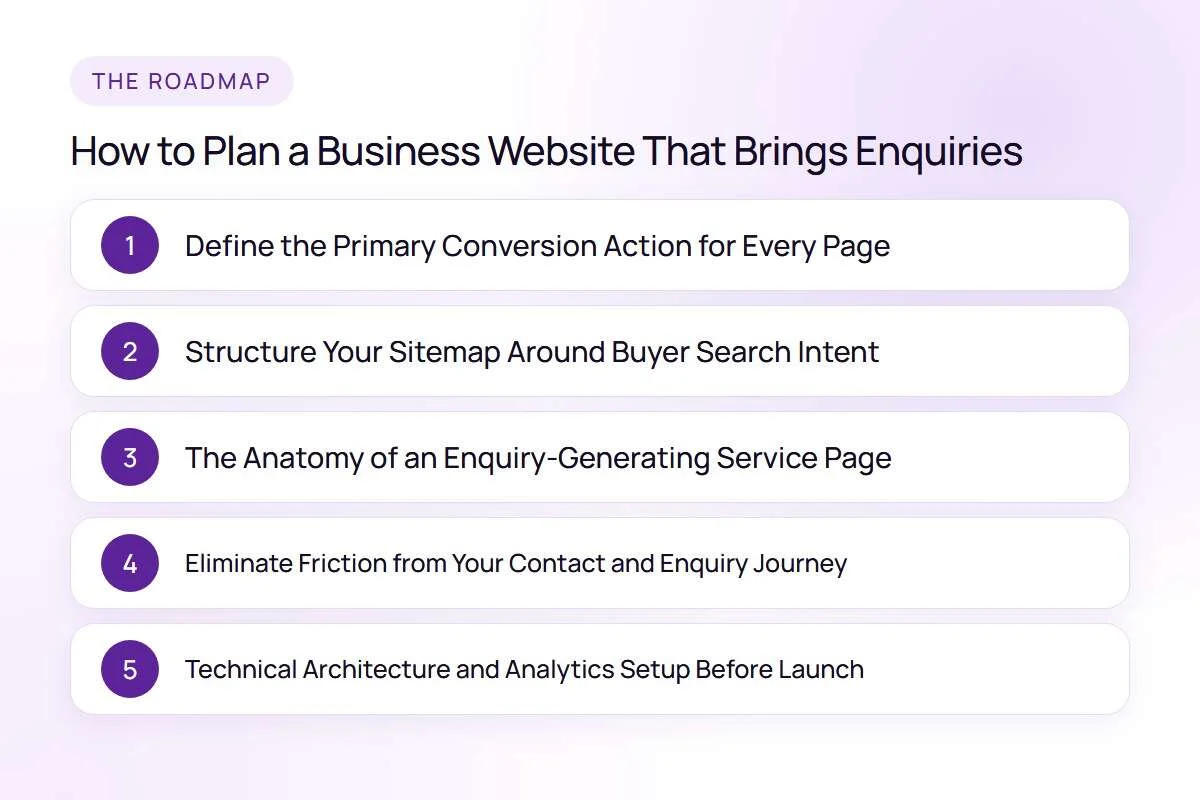
Planning an enquiry-generating website requires a structured, multi-phase methodology. Rather than jumping directly into visual design, colour palettes, or themes, successful businesses establish five foundational pillars: defining a single primary conversion goal for each page, mapping the sitemap directly to commercial search intent, structuring service pages around buyer objections, removing friction from contact forms, and deploying accurate event tracking before writing code. This guide walks you through the step-by-step framework to plan a commercial website that generates qualified leads month after month.
1. Define the Primary Conversion Action for Every Page
Before drafting wireframes or writing headlines, decide the exact transaction you expect from each URL. A service business rarely closes a client on the first visit; the realistic objective is securing a qualified enquiry, a phone conversation, or a structured project brief.
When a single webpage asks visitors to read a blog, follow social handles, download a guide, and request a quote, visitors experience decision paralysis and take no action.
To maintain maximum conversion focus across your web architecture:
- Assign one primary call to action per page: On service pages, keep it direct and high-intent, such as "Schedule a Technical Review" or "Request a Scope-Based Quote."
- Provide a low-friction secondary alternative: For prospects still evaluating options, offer a self-service resource, such as an interactive cost calculator or delivery timeline sheet.
- Maintain consistent CTA visibility: Your primary conversion button must remain accessible at all times using a clean header button and inline blocks after major sections.
- Set clear expectations: State clearly what happens after the prospect clicks, such as "Send Enquiry — We Respond Within 4 Business Hours."
2. Structure Your Sitemap Around Buyer Search Intent
Company founders often organise their website structure around internal departments. Prospective clients searching Google do not care about internal corporate divisions; they search for solutions to operational challenges—such as custom web portals, B2B catalogue systems, or automated quotation workflows.
To capture search volume and guide prospects smoothly toward an enquiry, design a flat sitemap where no essential commercial page is more than two clicks away from the homepage:
- Homepage: Declares who you help, the problems you solve, proof of verified client outcomes, and clear visual gateways into your core service hubs.
- Dedicated Service Pages: Standalone landing pages for each separate service offering. Grouping multiple services onto a single generic "Services" page damages search rankings and confuses buyers.
- Structured Case Studies: Project reviews that follow the "Problem → Architectural Solution → Measurable Business Outcome" framework.
- Commercial Pricing & Planning Resources: Transparent articles addressing budgeting considerations, implementation timelines, and platform comparisons.
- Contact and Discovery Page: Comprehensive contact details including registered office address, phone lines, embedded map location, and a clean enquiry form.
When you design this hierarchy, ensure logical internal linking. For example, your custom application pages should link naturally to your high-conversion web app development expertise and your dedicated landing page design services.
3. The Anatomy of an Enquiry-Generating Service Page
A high-converting service page acts as an interactive sales conversation. Instead of listing generic dictionary definitions, address your methodology, deliverables, and risk mitigation safeguards directly.
To convert organic visitors into sales meetings, structure your core service pages using this sequence:
- Above-the-Fold Value Block: A clear H1 heading, two sentences explaining target buyers, three proof badges, and a primary enquiry button.
- The Operational Problem: A candid breakdown of common issues buyers face—missed deadlines, poor code, hidden costs, or slow support.
- The Delivery Roadmap: A visual milestone chart showing Discovery, Wireframing, UI Design, Development, Testing, and Handover.
- Scope Itemisation Table: A clear summary contrasting standard deliverables against custom scoping.
- Verifiable Proof: Concrete examples showing how a similar client improved enquiry volume or site speed.
- Transparent FAQ Module: Direct answers regarding code ownership, hosting requirements, and warranty periods.
4. Eliminate Friction from Your Contact and Enquiry Journey
Every additional input field on your contact form introduces friction. Unless you need aggressive enterprise lead filtering, capture only what is essential to initiate a productive introductory conversation.
The table below outlines optimal form field design for commercial lead generation:
| Form Field | Status | Strategic Purpose & Best Practice |
|---|---|---|
| Full Name | Mandatory | Allows personal, professional follow-up communication. |
| Business Email | Mandatory | Primary communication channel; helps screen spam submissions. |
| Phone / WhatsApp Number | Highly Recommended | Essential in India and international trade where fast messaging accelerates deals. |
| Service Requirement | Dropdown Selector | 4 to 6 clean options; routes enquiries to the correct technical specialist immediately. |
| Approximate Budget Range | Optional Dropdown | Prevents budget misalignment while allowing cost-conscious prospects to enquire. |
| Project Summary | Optional Text Area | Provide helpful placeholder text: "Tell us about your core objective, timeline, or current site." |
Never leave visitors staring at the same page with a tiny confirmation message. Always redirect submissions to a dedicated /thank-you/ page for accurate GA4 goal tracking and clear guidance on next steps.
5. Technical Architecture and Analytics Setup Before Launch
Planning a lead-generation website is incomplete without verifying the underlying technical infrastructure. A beautifully designed website will fail to produce commercial results if search crawlers encounter indexing errors or if slow server response times frustrate mobile visitors.
Before development commences, establish these strict technical standards:
- Analytics and Tag Deployment: Configure Google Tag Manager container with event listeners for every form submission, click-to-WhatsApp link, telephone click, and brochure download. Verify these events in GA4 DebugView prior to marketing spend.
- Core Web Vitals Compliance: Mandate that Largest Contentful Paint (LCP) remains under 2.5 seconds on real mobile networks, and Cumulative Layout Shift (CLS) stays below 0.1. Sluggish websites lose prospective leads before the page finishes rendering.
- Structured Data Implementation: Incorporate comprehensive JSON-LD schema across the website, including Organization schema on the homepage and Service, BreadcrumbList, and FAQPage schema across commercial service pages.
- Local Trust and Entity Clarity: Display accurate Name, Address, and Phone Number (NAP) details matching your Google Business Profile across the site footer and contact template.
FAQs
How long does it take to plan an enquiry-focused business website properly?
A comprehensive planning phase typically spans one to two weeks. During this period, the team audits user search queries, constructs detailed user journeys, finalises the sitemap, writes conversion wireframes, and approves tracking requirements. Investing two weeks into planning prevents weeks of costly redesigns and code refactoring during active development.
Should we list our service prices on the website?
Providing realistic price ranges or starting figures is highly beneficial for service businesses. It sets realistic expectations, filters out prospects whose budgets do not match your operational costs, and positions your firm as transparent and confident. When custom scoping is required, explain the specific factors that influence final costs.
What is the ideal number of pages for a lead-generating corporate website?
Most service and B2B companies achieve strong search visibility and lead flow with 8 to 15 well-architected pages. This includes a homepage, 3 to 6 dedicated service pages, 2 to 4 detailed case study reviews, an about page establishing company credentials, and a focused contact hub. Quality and relevance always outperform high volumes of thin, duplicate pages.
Why do websites with high traffic often fail to produce enquiries?
High web traffic without enquiries indicates a severe intent mismatch or a broken conversion path. This happens when content attracts informational visitors seeking free tips rather than commercial buyers, or when pages lack clear value propositions, trustworthy proof points, and easy-to-use enquiry mechanisms.
Next Steps for Your Website Project
Planning a business website that brings consistent enquiries requires an uncompromising focus on user experience, commercial clarity, and technical speed. Rather than copying competitor layouts or settling for generic templates, align your website layout with the exact questions your ideal buyers ask before hiring an agency.
If you are planning a new website build or seeking to transform an existing corporate website into an active lead pipeline, explore our specialised high-conversion web app development solutions or contact IPrix Media to schedule a comprehensive pre-development strategy session.


