How to Write Video Ads From Real Customer Questions
Learn how to script high-converting video ads by mining real customer questions: 3-part script formulas, visual hooks, B-roll proof, and direct CTAs.
By IPrix Media Team, web development and digital marketing company in Udaipur
When business owners and marketing teams sit down to produce paid video ads for Meta, YouTube, or LinkedIn, they frequently make the mistake of sounding like a corporate television commercial. They hire actors, write elaborate cinematic scripts, and proclaim broad marketing slogans like "We deliver innovative, seamless business excellence."
Viewers scroll past these ads in less than two seconds. Modern consumers and business buyers have developed complete immunity to self-aggrandizing corporate advertising.
What actually stops the thumb and holds viewer attention? Hearing an exact, pressing question they have asked themselves, answered clearly with authentic, verifiable proof.
Here is the direct operational rule: Do not invent video ad concepts in a brainstorming meeting. Mine real customer questions directly from sales call notes, website chatbot logs, and customer support tickets. Structure each 30-to-60 second video ad using a 3-part framework: an objection-based hook in the first 3 seconds, a direct factual answer accompanied by on-screen B-roll proof in seconds 4 through 45, and a low-friction call-to-action in the final 15 seconds.
This operational guide provides the exact frameworks, storyboard templates, and scripting workflows required to turn customer questions into high-converting video advertisements.
1. Where to Mine High-Converting Customer Questions
The most persuasive video ad scripts already exist in your business; you simply need to transcribe them. Tap these four primary internal goldmines:
1. Website Chatbot and Customer Support Inquiries
Review your website’s live chat logs and customer service ticketing queues. What questions appear repeatedly from prospects before they buy?
- "How long does onboarding typically take?"
- "Will this software integrate with our existing Tally ERP?"
- "What happens if a custom component arrives damaged?"
Each recurring question represents an active psychological purchase barrier. Answering it directly in a video ad removes that friction before the prospect even reaches your sales team.
2. Recorded Sales Objection Notes
Interview your business development representatives (BDRs) and account executives. Ask them: "What is the single most common reason an interested prospect hesitates to sign our proposal?"
Whether the objection is price, transition downtime, or contract flexibility, address it head-on. A video ad that opens with "The biggest fear business owners have about switching CRM software is…" immediately commands intense buyer interest.
3. Customer Reviews and Reddit/Quora Communities
Audit competitor reviews on Google Business Profiles, Amazon, and industry review sites. Note the specific complaints buyers have about competing solutions. If competitors fail on delivery delays, your video ad can spotlight your guaranteed 48-hour dispatch protocol.
To deploy conversational chatbots that capture and categorize customer questions automatically, explore our AI chatbot development capabilities.
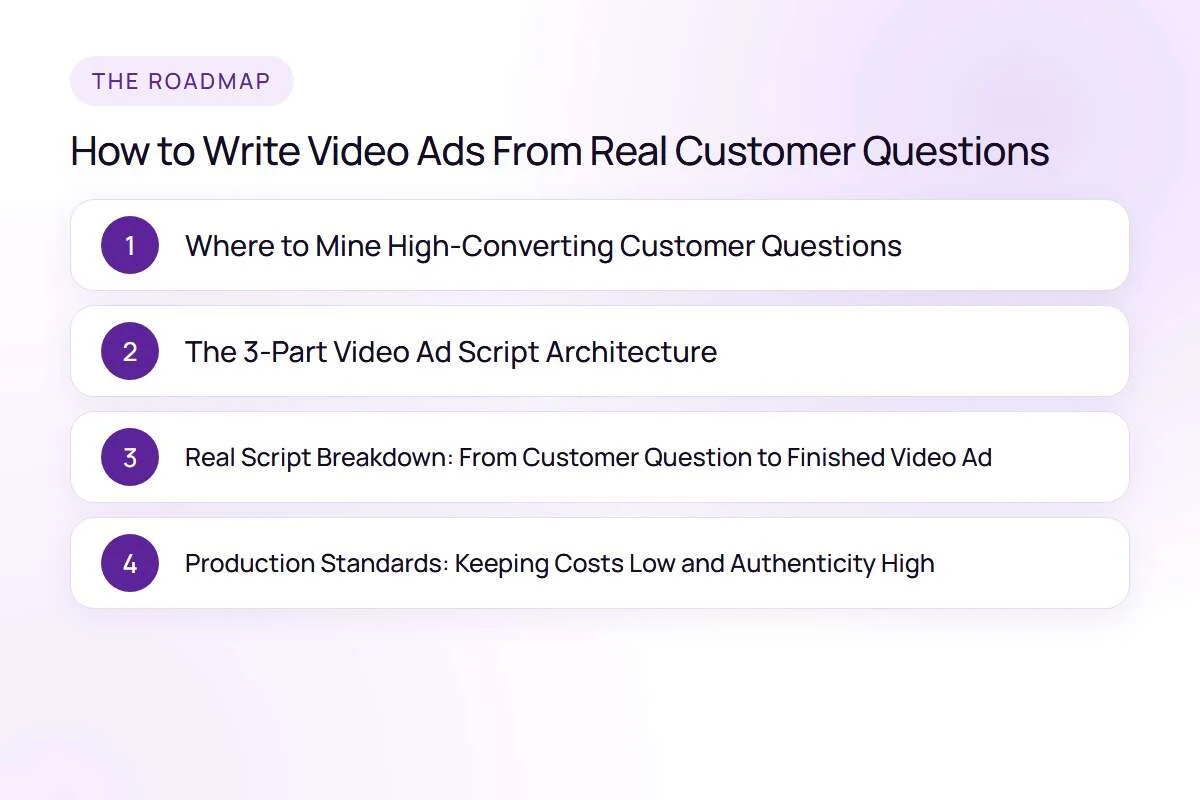
2. The 3-Part Video Ad Script Architecture
A profitable 45-to-60 second commercial video ad follows a disciplined psychological structure designed for mobile feed consumption:
[00:00 - 00:03] THE HOOK: The Exact Customer Question / Pain Point
        │
[00:04 - 00:40] THE CORE: Direct Answer + On-Screen Verifiable Proof
        │
[00:41 - 00:60] THE ACTION: Transparent Offer + Low-Friction Next Step
Part 1: The First 3 Seconds (The Hook)
On Instagram Reels, YouTube Shorts, and Meta ads, over 70% of viewers scroll away within the first 3 seconds. Never waste this opening on animated corporate logos, ambient background music, or saying "Hello everyone, welcome back to our channel."
- Visual Action: Founder or technical specialist holding the product, pointing directly to a real screen, or an on-screen text bubble displaying the exact question.
- Audio Dialogue: State the question immediately: "One of the most common questions Indian founders ask us is: Can a custom Shopify store really handle 5,000 flash sale orders in an hour without crashing?"
Part 2: Seconds 4 to 40 (Direct Answer + Visual Proof)
Answer the question directly in the very next sentence. Then, immediately transition to visual B-roll evidence.
- Talk is cheap in digital advertising. If you claim your web application is fast, cut to an unedited screen recording of a real Google PageSpeed Insights test scoring 98/100.
- If you claim your industrial packaging survives rough courier transit, show a slow-motion video of a carton being dropped from 2 meters onto concrete and opened to reveal undamaged glassware.
- Authentic, documentary-style footage captured on a clean smartphone consistently outperforms glossy, over-edited studio graphics because viewers perceive it as undeniable truth.
Part 3: Seconds 41 to 60 (The Low-Friction Call-to-Action)
Conclude with a clear, specific invitation. Avoid vague platitudes like "Contact us today." Tell the viewer exactly what will happen when they click:
- "Click the link below to input your website URL. Our engineering team will run a free 24-point mobile speed audit and email you the PDF breakdown within one business day."
To engineer high-performance video assets with scripted live demonstrations and AI voiceovers, explore our specialized AI-powered video production for business services.
3. Real Script Breakdown: From Customer Question to Finished Video Ad
Examine this complete 45-second script created for a commercial B2B service firm:
| Video Timestamp | Visual Action (What Viewer Sees) | Audio / Voiceover (What Viewer Hears) | On-Screen Text Overlay |
|---|---|---|---|
| 00:00 – 00:04 | Senior web engineer sitting at desk, looks directly into camera with laptop open. | "A client asked us last Tuesday: 'Why should we pay for custom WordPress development when we can buy a $49 theme on ThemeForest?'" | Why not just buy a $49 WordPress theme? |
| 00:05 – 00:15 | Screen recording zooms in on a bloated theme file containing 45 unneeded plugins and 3.8MB of unused CSS. | "Here is the brutal truth. Commercial marketplace themes bundle thousands of lines of unused code to appeal to everyone. That slows your page down to 4.8 seconds on mobile." | Marketplace Themes = 4.8s Mobile Load Time |
| 00:16 – 00:28 | Cut to side-by-side performance test showing custom theme loading in 0.9 seconds with zero plugin bloat. | "Our custom themes are coded specifically for your business. Zero bloated plugins. Your site loads in under one second, which Google rewards with higher organic rankings." | Custom Code = 0.9s Load Time & Better SEO |
| 00:29 – 00:40 | Cut to engineer scrolling through client lead generation dashboard showing 3x increase in quote requests. | "For our client ABC Logistics, this architectural shift boosted mobile enquiry submissions by 72% in the first 60 days." | +72% Mobile Enquiries in 60 Days |
| 00:41 – 00:50 | Engineer holds up diagnostic report. Logo and URL appear cleanly. | "Want to see how your current site scores? Click the link below to request our free 10-point code and speed audit." | Click Below: Free 10-Point Website Audit |
4. Production Standards: Keeping Costs Low and Authenticity High
You do not need a ₹5,00,000 video production budget to shoot customer-question ads. In fact, hyper-produced commercials often look like blatant ads and trigger instant skips.
Enforce these three minimalist production rules:
- Pristine Wireless Audio: Viewers will forgive amateur 1080p video, but they will instantly abandon an ad with muffled, echoey, or windy audio. Invest in a quality wireless lavalier microphone (such as DJI Mic or Rode Wireless GO).
- Dynamic On-Screen Captions: Over 65% of mobile social feeds are consumed with the volume muted. Burn animated captions (using tools like CapCut or Premiere Pro) directly into the video frame with high-contrast text.
- Pacing and Micro-Cuts: Never let a single visual frame remain static for more than 4 seconds. Insert B-roll overlays, zooms, or on-screen text highlights every 3 to 4 seconds to maintain visual momentum.
FAQs
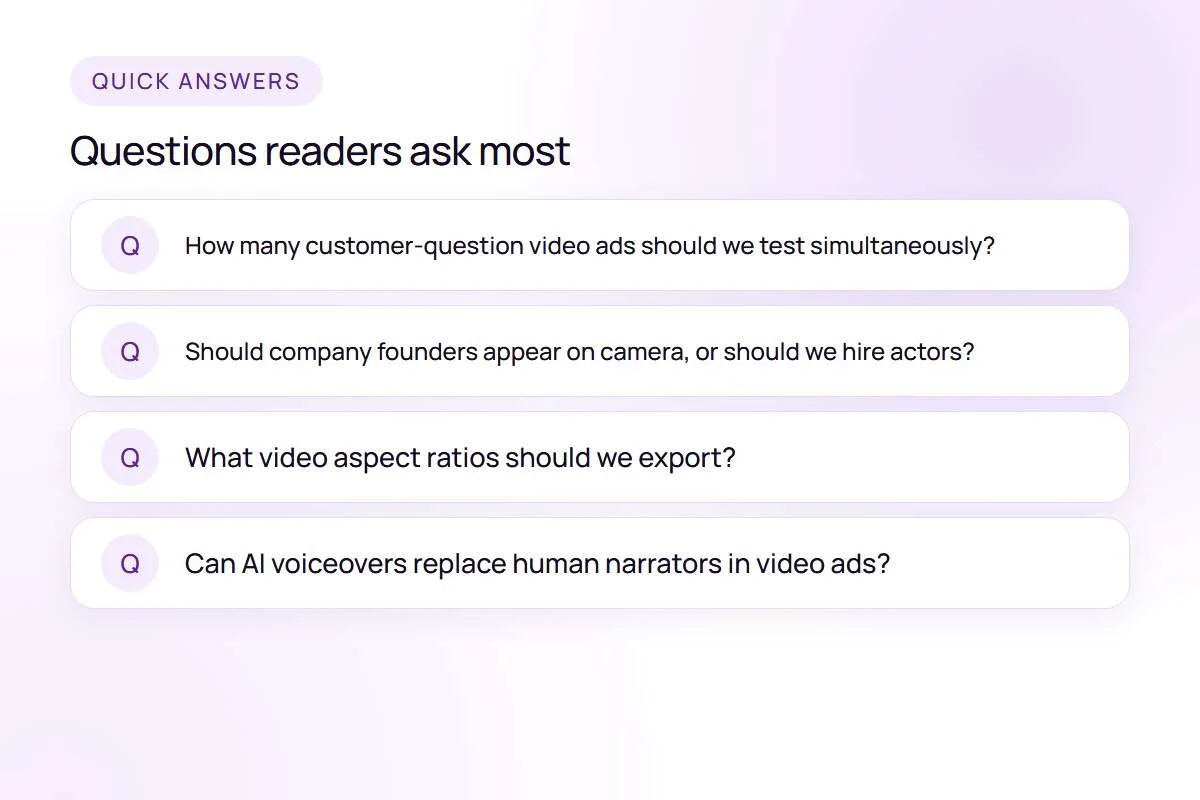
How many customer-question video ads should we test simultaneously?
Start by scripting and shooting five distinct customer questions in a single production session. Run all five simultaneously inside a Meta or YouTube paid campaign with equal daily budgets. Within 7 to 10 days, performance metrics will clearly identify the 1 or 2 scripts that generate the lowest cost-per-lead.
Should company founders appear on camera, or should we hire actors?
Founders, lead engineers, and real customer service managers consistently outperform hired actors. Viewers subconsciously detect professional actors and treat the message as paid theater. A founder speaking candidly from their real office projects unshakeable authenticity.
What video aspect ratios should we export?
Always export two primary formats: 9:16 vertical (1080×1920) for Instagram Reels, YouTube Shorts, and TikTok; and 16:9 landscape (1920×1080) for desktop YouTube in-stream and LinkedIn feed ads.
Can AI voiceovers replace human narrators in video ads?
Modern AI voice synthesis tools (like ElevenLabs) sound remarkably human and are excellent for rapid testing. However, pairing an AI voice with authentic, real-world footage of your actual team and facilities yields the highest credibility.
Next Steps for Your Paid Video Strategy
Video ads built from genuine customer questions remove the guesswork from marketing creative. By validating real objections and presenting clear, on-screen proof, your business transforms paid advertising into an authentic engine for customer acquisition.
If your company wants to script, shoot, and scale high-converting commercial video ads or integrate automated AI customer inquiry funnels, explore our AI-powered video production services or connect with IPrix Media today for a strategic creative consultation.