
Website Design Checklist Before Hiring an Agency
A pre-hiring website design checklist for business owners: scope definition, CMS ownership, deliverables, red flags, and milestone payment schedules.
By IPrix Media Team, web development and digital marketing company in Udaipur

Hiring a web design agency is one of the most consequential decisions a business founder or marketing leader makes. When executed properly, a redesigned website becomes your company's most productive commercial asset—attracting qualified search traffic, establishing unquestioned market authority, and delivering consistent inbound sales inquiries.
Unfortunately, many web design engagements end in severe disappointment. Projects drag on for six months past the agreed deadline, initial budgets double due to surprise "out-of-scope" charges, and the final deliverable looks like a cookie-cutter template that runs sluggishly on mobile devices. In the worst scenarios, clients discover at launch that the agency registered the domain name in their own name and refuses to hand over administrative credentials without an ongoing maintenance ransom.
These painful outcomes rarely happen because the business picked a malicious partner; they happen because the business hired an agency before defining its internal requirements, legal ownership terms, and technical acceptance standards.
This comprehensive pre-hiring checklist provides business owners with the exact vetting framework required to evaluate agencies, draft airtight scope documents, and protect company capital before signing a contract.
1. Internal Clarity: Define Your Business Requirements First
The most common reason for project delays is "scope creep", which happens when a client hires an agency without knowing what they actually need. If you ask an agency to quote on a "clean, professional website" without detailing specific workflows, the agency will quote on basic assumptions that inevitably conflict with your real expectations.
Before reaching out to agencies, complete this internal scoping audit:
- Target Audience and Buying Decision: Who is the primary visitor? Are they high-ticket B2B procurement managers who need deep technical case studies, or retail shoppers who require instant WhatsApp checkout?
- Core Functionality Inventory: List every non-standard feature required: custom price calculators, customer portal logins, multi-language toggles, third-party ERP integrations, or automated calendar booking.
- Content and Asset Readiness: Decide who is responsible for writing commercial page copy and supplying photography. If your internal team cannot produce high-quality copywriting, mandate professional copywriting within the agency's formal scope of work.
- Realistic Launch Timeline: Establish your hard launch deadline (such as an upcoming trade exhibition or product launch) and communicate this before contracts are drafted.
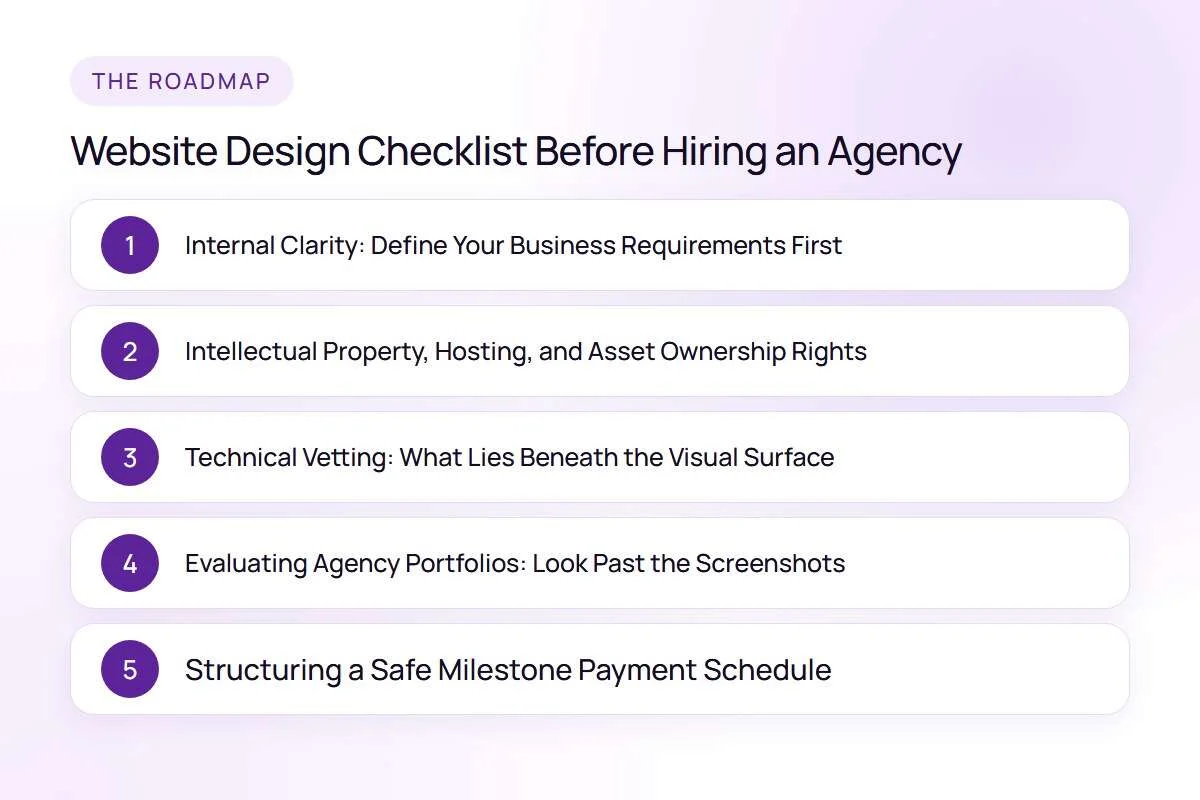
2. Intellectual Property, Hosting, and Asset Ownership Rights
The single most dangerous clause in a web development contract concerns ownership. Some agencies hold client websites hostage by retaining ownership of the custom code, design files, or hosting servers, forcing clients into expensive perpetual retainers.
Demand clear written confirmation on these four ownership terms:
| Asset Category | Mandatory Contract Clause | Why It Protects Your Company |
|---|---|---|
| Domain Registration | Registered in the client's direct name and corporate email | Prevents the agency from holding your web address hostage if a dispute arises. |
| Source Code & Database | 100% intellectual property ownership transferred upon final payment | Allows you to migrate your site to any hosting provider or internal developer freely. |
| Design Master Files | Full access to Figma, Adobe XD, or Illustrator source files | Essential if you need another designer to create matching marketing collateral later. |
| Administrative Access | Full Super-Administrator credentials to WordPress/Shopify and DNS | Ensures your internal team maintains ultimate administrative control. |
At our agency, we build bespoke web architectures with total intellectual property transparency through our custom website design division.
3. Technical Vetting: What Lies Beneath the Visual Surface
Anyone can assemble an attractive visual layout using bloated drag-and-drop templates. However, an agency that prioritizes superficial aesthetics over technical engineering will deliver a slow, insecure website that Google's search crawlers struggle to rank.
During your agency interview, ask these five technical questions:
- "How do you ensure pages pass Google Core Web Vitals on mobile?" Be wary of agencies that shrug off mobile speed. A competent agency specifies that mobile Largest Contentful Paint (LCP) will stay under 2.5 seconds.
- "Do you build on custom, lightweight themes or heavy multi-purpose marketplace themes?" Bloated marketplace themes loaded with 50 unused features degrade server response times and break during plugin updates.
- "What is your approach to on-page SEO during the build?" The agency should explicitly include custom title tags, meta descriptions, heading structure (one H1 per page), image alt attributes, and JSON-LD structured data schema.
- "How do you handle staging and deployment?" Professional agencies build on private staging servers and perform zero-downtime database migrations, rather than experimenting directly on your live domain.
For businesses seeking to maximize paid and organic traffic, verify whether the agency also builds high-converting landing page design frameworks.
4. Evaluating Agency Portfolios: Look Past the Screenshots
Never judge an agency solely by a static portfolio page filled with glossy laptop mockups. Mockups do not prove that a website works, loads fast, or produces commercial sales for the client.
Execute this 3-step live portfolio audit:
- Test Real, Live Client Websites: Ask for direct links to 3 websites the agency built in the past twelve months. Open them on your own smartphone over a 4G connection. Does the navigation feel snappy? Do the forms work smoothly?
- Run a PageSpeed Test: Input the live client URL into Google PageSpeed Insights. If an agency's own showcase projects score in the red (below 50 on mobile), they will likely deliver a sluggish website to you as well.
- Request a Direct Client Reference: Ask to speak with one past client over a brief phone call. Ask the client: "Did the agency deliver on time, were there unexpected extra charges, and how responsive was their post-launch support?"
5. Structuring a Safe Milestone Payment Schedule
Never pay 100% of a project fee upfront, and be cautious of agencies demanding 50% upfront with the remaining 50% due on an arbitrary calendar date rather than upon milestone approval.
A safe, fair milestone payment schedule aligns financial incentives with deliverables:
- Milestone 1 (25% to 30%): Project Initiation, Discovery, Sitemap Approval, and Wireframe Sign-Off.
- Milestone 2 (25% to 30%): Full Visual UI Design Approval (Figma mockups approved for all core pages).
- Milestone 3 (25%): Functional Development Complete on Staging Server (forms working, content populated, speed tested).
- Milestone 4 (15% to 20%): Final Live Deployment, Domain Pointing, DNS Cutover, and Administrative Handover.
In addition, insist on a 30-day post-launch warranty period during which the agency must resolve any technical bugs, broken forms, or display errors at zero additional charge.

FAQs
What is a realistic cost for a professional custom business website in India?
For a tailored corporate business website (8 to 15 pages) featuring bespoke UI/UX design, custom WordPress development, speed optimization, and on-page SEO, realistic agency pricing typically ranges from ₹35,000 to ₹1,50,000. Complex e-commerce stores or custom web portals with third-party software integrations start from ₹80,000 to ₹3,50,000+.
How long does an agency take to deliver a custom website?
A disciplined agency delivery timeline typically spans 4 to 8 weeks. This accommodates 1 to 2 weeks for planning and wireframing, 2 weeks for UI design revisions, 2 weeks for clean development, and 1 week for content population, testing, and deployment.
What is the biggest red flag when talking to an agency?
The biggest red flag is an agency that promises an exact price quote and delivery timeline before asking detailed questions about your target audience, required functionalities, and content readiness. Agencies that skip discovery are selling pre-made commodity templates.
Who should provide website content and images?
If your internal team has skilled copywriters and commercial photography, you can supply your own assets. However, if your team lacks writing resources, hire an agency that provides integrated copywriting. Providing poor-quality text will compromise even the most beautiful design.
Next Steps for Your Website Project
Hiring a web design agency does not have to be an uncertain gamble. By establishing your functional requirements early, securing complete intellectual property ownership, demanding mobile performance standards, and tying payments to verified milestones, you position your project for seamless execution and lasting commercial success.
If your company is planning a website redesign or seeks an experienced engineering partner committed to transparent delivery and measurable business outcomes, explore our bespoke custom website design services or contact IPrix Media for a pre-development consultation today.