Brand Identity Checklist for a New Business
A complete brand identity checklist for new businesses: logo architecture, typography standards, color psychology, and digital brand guidelines.
By IPrix Media Team, web development and digital marketing company in Udaipur
When launching a new business, many founders confuse having a quick logo with possessing a complete brand identity. They pay a freelance designer to sketch a symbol, slap it on a business card, and assume their branding is finished.
Six months later, problems emerge. The logo looks illegible on a 16×16 pixel website favicon. The colors look vibrant on an iPhone screen but print as dull mud on corrugated packaging. Marketing materials created by different team members use conflicting fonts and clashing layouts. Instead of projecting a cohesive, trustworthy enterprise, the company appears amateurish and fragmented.
A complete brand identity is the visual and verbal operating system of your business. It governs how your company looks, speaks, and feels across every customer touchpoint—from physical office signage and product packaging to digital ads, social reels, and website interfaces.
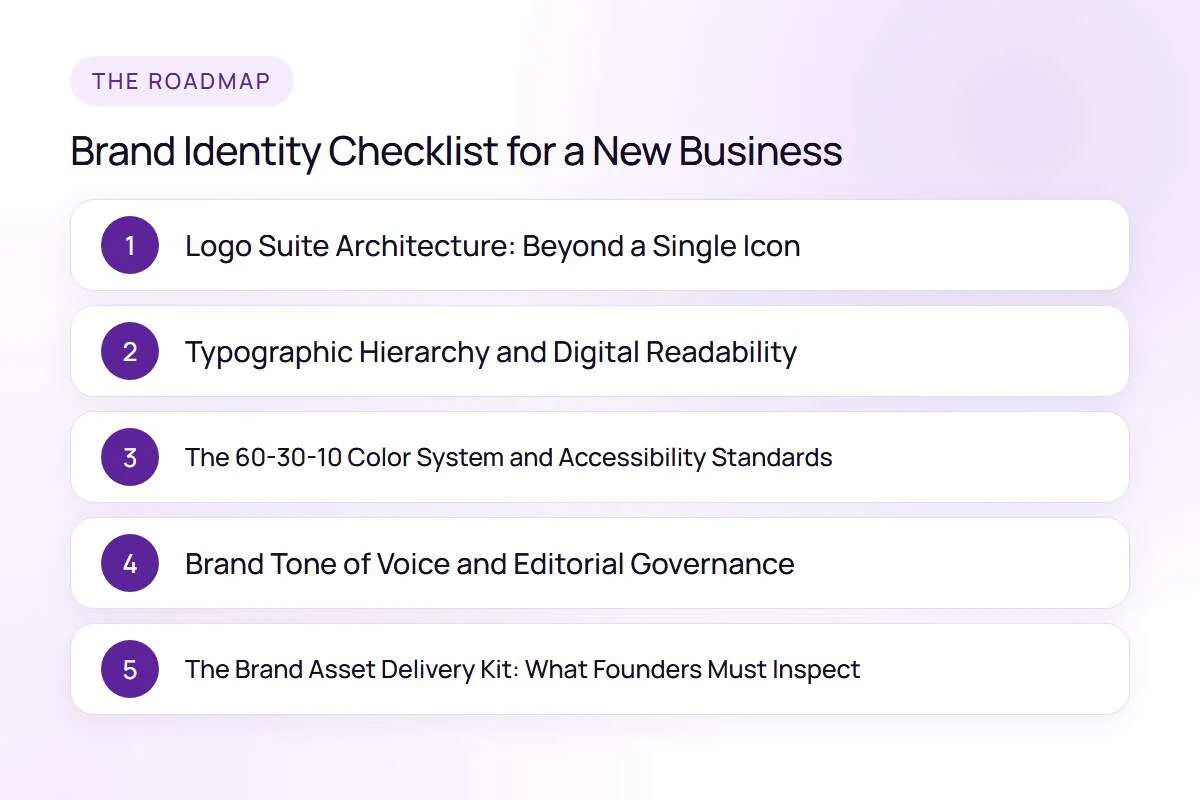
Here is the direct operational rule: Before launching any public marketing campaign, audit your brand identity against five core pillars—vector logo adaptability across micro-dimensions, a dual-font typographic hierarchy, a mathematically balanced color palette with defined accessibility contrast ratios, standardized tone-of-voice guidelines, and an exportable digital asset library.
This comprehensive checklist guides founders and marketing teams through every asset and standard required to build an enduring, enterprise-grade brand identity.
1. Logo Suite Architecture: Beyond a Single Icon
A professional brand identity requires a complete logo family, not just a single static graphic. Your visual mark must adapt effortlessly across different screen orientations, light and dark backgrounds, and microscopic digital constraints.
Inspect your logo suite against these pass/fail criteria:
- Primary Horizontal Lockup (Pass/Fail): Does your designer provide the full brand name alongside the icon in a horizontal format? This is essential for website navigation headers and official letterheads.
- Stacked Vertical Lockup (Pass/Fail): Do you possess a centered, stacked version for square applications, apparel embroidery, and circular social media profile images?
- Simplified Monogram or Favicon Mark (Pass/Fail): Can your icon scale down to a 32×32 pixel website favicon or a tiny Instagram story icon and remain instantly recognizable without visual blur?
- Monochrome & Inverted Variations (Pass/Fail): Does the logo function cleanly in pure single-color black and pure single-color white? If your logo relies solely on color gradients to be legible, it will fail on single-color print mediums like thermal shipping labels and engraved metal.
- Vector Master Source Files (Pass/Fail): Do you have delivery of vector master files (
.AI,.EPS,.SVG) in addition to raster images (.PNG,.WEBP)? Never accept only JPEG images from a designer.
To create scalable vector assets engineered for longevity, explore our bespoke logo design services.
2. Typographic Hierarchy and Digital Readability
Typography conveys subconscious authority before a prospect reads a single word. A fragmented font system erodes credibility. Your brand guideline must codify exactly two, and at most three, complementary typefaces:
| Font Level | Font Type / Category | Purpose and Technical Rules | Verification Check |
|---|---|---|---|
| Primary Display Font | Distinctive Serif or Geometric Sans | Used strictly for H1 page titles and marketing hero headlines. Reflects brand personality. | Must remain legible at large display sizes without awkward letter-spacing. |
| Secondary Body Font | Highly Legible Workhorse Sans (e.g., Inter, Plus Jakarta Sans) | Used for all paragraph copy, blog editorial text, technical specs, and contracts. | Must have multiple weights (Regular, Medium, Semi-Bold) and high readability at 14px–16px. |
| Functional Accent Font (Optional) | Monospace or Subtle Script | Used sparingly for code snippets, pricing tags, or seasonal packaging labels. | Must never be used for continuous paragraphs or critical navigation links. |
Ensure your typography rules specify exact line-height (leading), letter-spacing (tracking), and responsive font-size scales for mobile and desktop screens.
3. The 60-30-10 Color System and Accessibility Standards
Color is the most emotionally evocative component of brand identity. However, selecting colors arbitrarily creates visual chaos. Professional brand systems deploy the 60-30-10 Rule:
- Dominant Base Color (60%): Clean canvas tones—often crisp off-white, light gray, or deep midnight slate for dark modes. This provides comfortable visual breathing room.
- Secondary Brand Color (30%): The primary color that establishes your visual brand identity (e.g., navy blue, forest green, deep burgundy). Used across headers, navigation elements, and structural cards.
- High-Contrast Accent Color (10%): A vibrant, contrasting hue (e.g., electric amber, emerald, coral) reserved exclusively for high-intent actions—such as primary CTA buttons, enquiry links, and promotional badges.
Digital Accessibility and Contrast Validation
Never finalize brand colors purely in design software. Run every color pairing through the Web Content Accessibility Guidelines (WCAG) contrast checker:
- WCAG AA Compliance: Body text must maintain a minimum contrast ratio of 4.5:1 against the background.
- Large Text Compliance: Headlines must maintain at least 3:1 contrast.
- If your brand orange text on a white background yields a 2.1:1 ratio, human visitors cannot comfortably read your message, and search engines may flag your interface for accessibility flaws.
To maintain visual rigor across promotional campaigns, align your brand system with our high-impact ad creatives and design assets.
4. Brand Tone of Voice and Editorial Governance
Brand identity extends beyond visual graphics; it dictates how your brand communicates through written language:
- Brand Archetype & Personality: Are you a serious, authoritative technical partner, or an energetic, approachable consumer catalyst? Define three tonal anchors (e.g., "Direct, Technical, Pragmatic; never Academic, Fluffy, or Arrogant").
- Vocabulary and Industry Lexicon: Define preferred terminology. For example, do you refer to clients as "partners", "customers", or "clients"?
- Restricted Clichés and AI Jargon: Strictly forbid generic filler phrases in your company's marketing copy. Ban words like "synergy", "cutting-edge", and "revolutionize" from all corporate documentation.
5. The Brand Asset Delivery Kit: What Founders Must Inspect
When your branding agency completes your project, do not accept a loose folder of files. Demand a standardized Brand Identity Master Archive organized as follows:
/Brand_Identity_Master_Package/
├── 01_Logos/
│   ├── Vector_Source/ (.AI, .EPS, .SVG)
│   ├── Digital_Web/ (.PNG transparent, .WEBP)
│   └── Print_CMYK/ (High-res 300 DPI vector PDF)
├── 02_Typography/
│   ├── Licensed Web Fonts (.WOFF2, .TTF)
│   └── Font Pairing Hierarchy Documentation
├── 03_Color_Palette/
│   └── Color Swatches (HEX, RGB, CMYK, Pantone PMS values)
├── 04_Brand_Guidelines_Book/
│   └── Comprehensive Brand Identity Manual (.PDF)
└── 05_Collateral_Templates/
    └── Editable Business Cards, Presentation Deck, Social Templates
FAQs
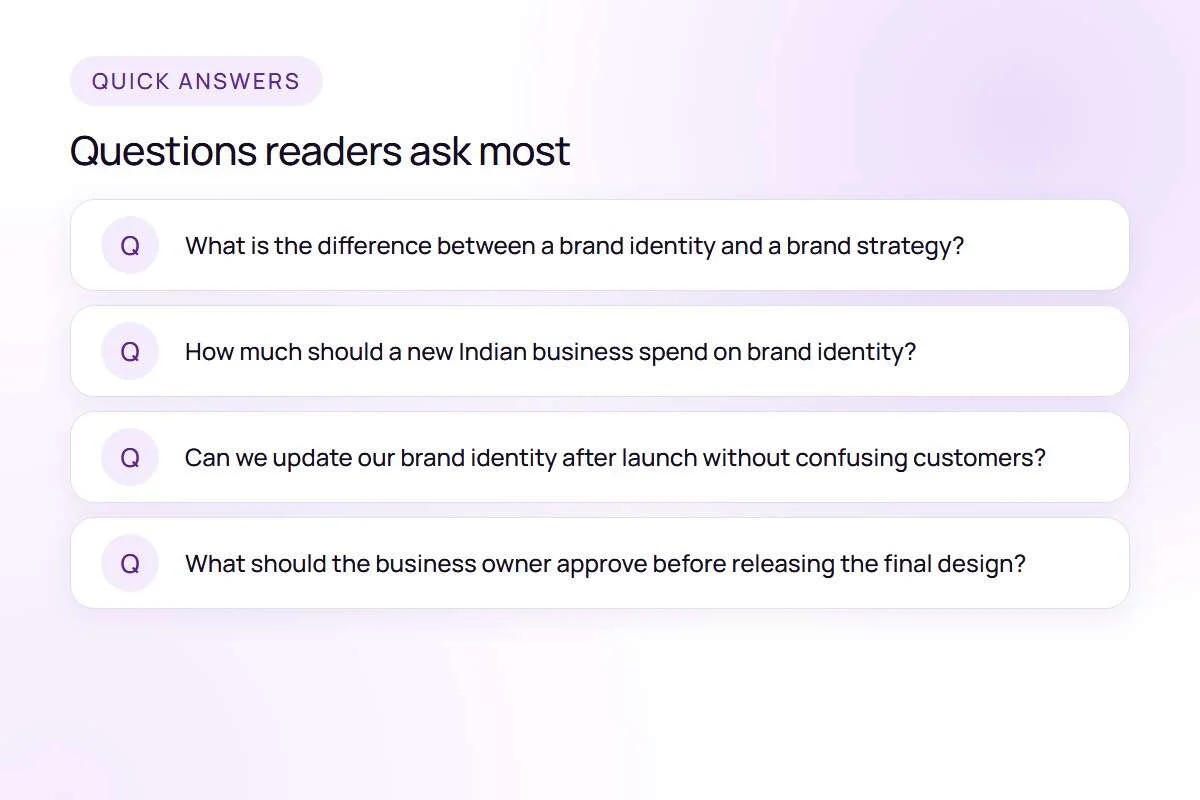
What is the difference between a brand identity and a brand strategy?
Brand strategy is the foundational business plan: target audience, competitive positioning, value proposition, and market differentiation. Brand identity is the sensory execution of that strategy: the logo, colors, typography, packaging, and verbal tone that make the strategy visible to customers.
How much should a new Indian business spend on brand identity?
Brand identity costs vary based on company scale. Early-stage startups can secure a solid visual identity system between ₹30,000 and ₹75,000. Growing mid-market enterprises investing in multi-channel collateral, trademark verification, and detailed brand manuals typically invest ₹1,50,000 to ₹5,00,000+.
Can we update our brand identity after launch without confusing customers?
Yes. Brand refreshes are normal as companies mature. However, changing core logos and colors every six months destroys brand equity. Build a timeless, minimalist identity at launch so future updates require subtle modernizations rather than disruptive overhauls.
What should the business owner approve before releasing the final design?
The owner must review the complete vector package, verify trademark clearance with a legal professional, confirm mobile legibility down to 16px, and test physical CMYK print proofs on real paper or packaging stock.
Next Steps for Your Business Brand
A cohesive brand identity is not a cosmetic luxury; it is a powerful commercial asset that commands higher pricing, accelerates customer trust, and makes all future marketing campaigns dramatically more effective.
If your new business is ready to develop an iconic logo, comprehensive brand guidelines, and high-converting marketing collateral, explore our logo design and brand identity services or contact IPrix Media today for a creative consultation.