Logo Design Brief: What to Tell Your Designer
A comprehensive guide to writing an effective logo design brief: business positioning, typography preferences, colour theory, deliverables, and review.
By IPrix Media Team, web development and digital marketing company in Udaipur
Commissioning a new logo for your business is an important milestone, but for many founders and marketing managers, the process turns into an exhausting cycle of endless revisions and frustration. A founder hires a talented designer, provides a vague instruction like "We want something modern, premium, and clean", and then feels disappointed when the initial concepts fail to capture the true essence of their brand.
The problem in ninety percent of failed design projects is not the designer's technical skill; it is the absence of a structured, comprehensive logo design brief.
A logo designer is not a mind reader. They are a visual communicator who translates business strategy into shapes, typography, and color harmony. If you feed them ambiguous instructions, you force them to guess your aesthetic taste and commercial positioning. Conversely, when you provide a clear, disciplined creative brief, you empower your designer to produce distinctive, memorable concepts that resonate with your ideal buyers and endure for decades.
This practical guide provides a complete, section-by-section framework to write a professional logo design brief, detailing exactly what information to provide, common traps to avoid, and how to evaluate design concepts with commercial objectivity.
1. Company Profile, Core Mission, and Unique Value Proposition
Before discussing colors, fonts, or visual symbols, your designer must understand the fundamental commercial engine of your company. A logo for a high-volume budget e-commerce brand requires a completely different visual psychology than a logo for an elite corporate law consultancy.
In the introductory section of your brief, answer these strategic questions:
- What does your company actually do? Describe your core products or services in simple, non-corporate language.
- Who is your ideal customer? Detail your primary audience demographics: are you selling to corporate enterprise procurement heads, tech-savvy millennial consumers, or traditional local manufacturing owners?
- What is your Unique Value Proposition (UVP)? Why do clients hire your firm instead of competitors? Are you known for technical precision, speed of execution, accessible affordability, or bespoke craftsmanship?
- What is your price positioning? Are you positioned as a luxury premium tier, mid-market value, or accessible budget volume? This single factor dictates whether typography should feel understated and minimalist or bold and energetic.
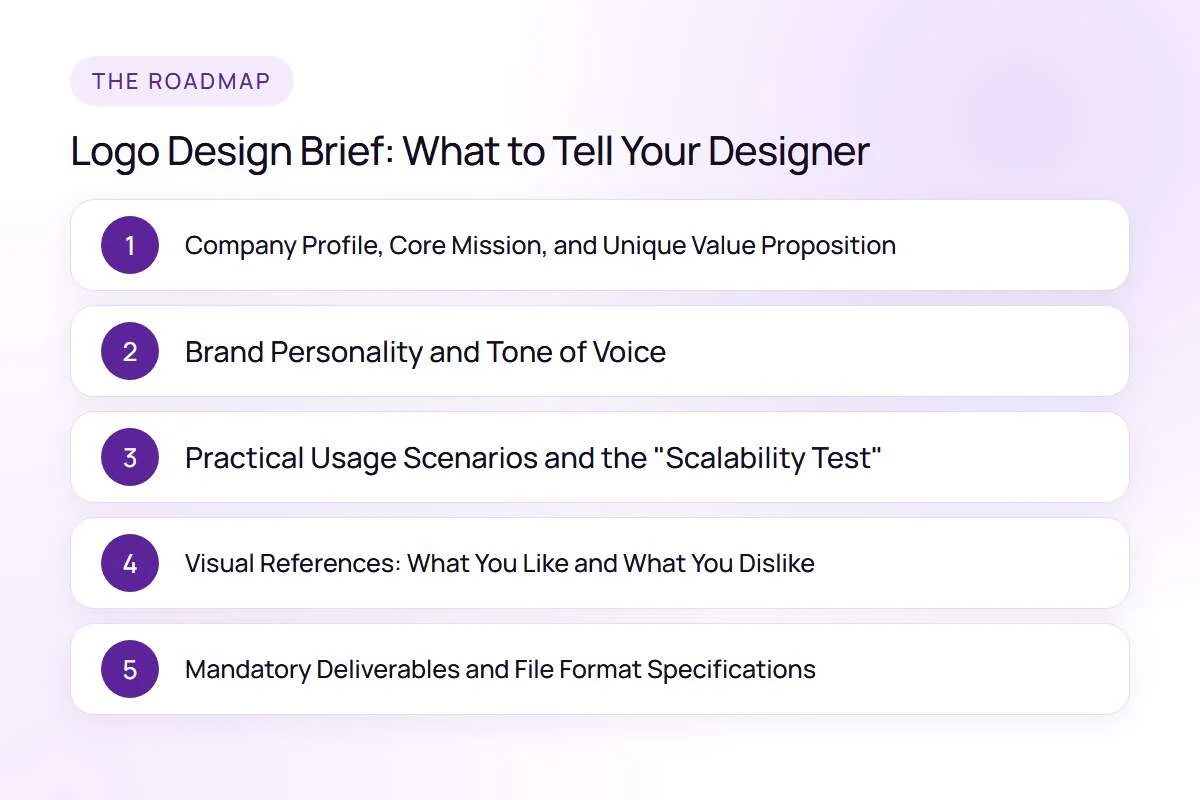
2. Brand Personality and Tone of Voice
Founders often struggle to articulate their visual preferences. A powerful technique to bridge the communication gap between business owners and designers is using Brand Personality Attributes.
Select where your company falls across these five classic brand identity spectrums:
| Brand Dimension | Traditional / Conservative | Mid-Ground | Modern / Disruptive |
|---|---|---|---|
| Formality | Corporate, established, authoritative | Approachable, professional | Casual, rebellious, playful |
| Aesthetic Tone | Classical, timeless, heritage | Balanced, clean | Contemporary, minimalist, futuristic |
| Market Energy | Calm, deliberate, reassuring | Steady, active | Dynamic, bold, high-octane |
| Price Signal | Understated luxury, exclusive | Practical, competitive | Mass-market, accessible, friendly |
| Visual Complexity | Detailed heraldry, rich crest | Balanced wordmark + icon | Abstract geometric, hyper-simplified |
Providing your designer with these calibrated scales eliminates subjective confusion and gives them an objective design target.
For businesses looking to build a cohesive corporate identity, explore our specialized logo design services and complete branding packages.
3. Practical Usage Scenarios and the "Scalability Test"
A modern logo lives across hundreds of diverse physical and digital mediums. A design that looks stunning on a large white presentation slide may become completely illegible when reduced to a 16×16 pixel website favicon or embroidered on a staff uniform polo shirt.
In your design brief, explicitly state all environments where your logo will appear:
- Digital Viewports: Website header, mobile app icon, social media profile circles, email signatures, and video watermarks.
- Physical Collateral: Business cards, letterheads, corporate invoices, branded merchandise, and packaging boxes.
- Signage and Environment: Exterior building signs, vehicle wraps, acrylic office lobby displays, and exhibition booths.
- Embroidered and Monochromatic Uses: Uniform embroidery, single-color laser engraving, and black-and-white fax or newsprint documents.
Specifying these use cases upfront ensures your designer creates a versatile vector system with appropriate secondary variations—such as a horizontal primary logo, a stacked vertical lockup, and a standalone favicon mark.
4. Visual References: What You Like and What You Dislike
Showing visual examples is the fastest way to align expectations. However, simply sending three random logos without explanation is unhelpful. You must articulate why a particular reference appeals to you.
Include these three reference categories in your brief:
- Direct Competitor Audit: Provide links to your 3 to 5 primary competitors. Point out what visual elements feel dated or generic in your industry, and state clearly how your brand wants to visually stand out from the pack.
- Inspirational References (Inside or Outside Your Industry): Share 3 to 5 logos from brands you admire. Explain specifically what resonates: "We like the clean geometric typography of Brand A, the warm earthy color palette of Brand B, and the clever negative-space icon of Brand C."
- The "Anti-Portfolio" (What to Avoid): Equally important is stating what you explicitly do not want. If you detest swooshes, globes, lightbulb icons, or script calligraphy fonts, document these dislikes clearly to save days of wasted design iterations.
If your marketing strategy also requires high-performing advertising graphics and promotional assets, explore our ad creatives design studio capabilities.
5. Mandatory Deliverables and File Format Specifications
A professional logo project is not just a single JPEG image. When your project concludes, you require a comprehensive brand asset kit formatted for commercial production.
Demand these mandatory deliverables in your project scope:
- Vector Master Files: Fully scalable vector files (
.AI,.EPS,.SVG) that can be resized to the size of a highway billboard without losing sharpness. - Web-Optimised Transparent Files: High-resolution transparent PNG and modern WebP files in full color, all-white (reverse), and all-black variations.
- Social Media Pack: Pre-sized square and round profile images optimized for LinkedIn, Instagram, X, and Facebook.
- Basic Brand Style Sheet: A one-page reference document specifying exact primary and secondary color codes (HEX, RGB, CMYK, and Pantone) and corporate typography font families.
FAQs
How long does a professional logo design process take?
A thorough, research-driven logo design process typically spans 2 to 4 weeks. This allows sufficient time for competitor research, concept ideation, typography pairing, client feedback rounds, and final vector file preparation. Be wary of services promising a finished custom logo in 24 hours, as they almost always rely on recycled stock templates.
What is the difference between a wordmark, a lettermark, and a combination mark?
A wordmark focuses entirely on stylized typography of your business name (such as Google or Visa). A lettermark uses initials or acronyms (like IBM or NASA). A combination mark pairs a distinct visual icon or symbol alongside the typography (such as Nike or Adidas). For most growing service businesses, a combination mark provides the highest versatility.
How many initial design concepts should a designer present?
A professional brand designer typically presents 2 to 4 distinct conceptual directions, each exploring a different strategic angle. Presenting ten or twenty concepts is a sign of template-driven churning rather than disciplined creative problem-solving.
How should a business owner evaluate design concepts objectively?
Do not ask, "Do I personally like this color?" Ask, "Does this mark effectively communicate our value to our ideal customer, and will it be readable on a smartphone screen and a building sign?" Evaluating design through the eyes of your customer prevents subjective internal disagreements.
Next Steps for Your Brand Identity
A logo is the visual cornerstone of your company's market reputation. It is the visual shorthand that clients associate with your reliability, your quality, and your professionalism. By investing the time to write a thorough, strategic logo design brief, you set your project up for complete creative and commercial success.
If your company is launching a new venture or planning a comprehensive brand identity redesign, explore our specialized logo design services or contact IPrix Media to consult with our senior brand strategists today.