Shopify Store Setup Checklist for First-Time Indian Sellers
A complete Shopify setup checklist for Indian sellers: GST compliance, Razorpay and Cashfree integration, COD verification, Shiprocket setup, and launch.
By IPrix Media Team, digital marketing agency in Udaipur

Launching an online store in the Indian e-commerce market requires far more than picking a theme and uploading product photographs. While Shopify provides an intuitive foundation for global commerce, selling to Indian consumers involves distinct operational complexities: mandatory GST billing, complex state-wise tax brackets, high reliance on Unified Payments Interface (UPI), elevated Cash on Delivery (COD) return-to-origin (RTO) risks, and multi-carrier courier integrations. When first-time sellers launch without addressing these local requirements, they experience abandoned shopping carts, customer disputes, delayed courier pickups, and wasted marketing budgets.
This practical checklist is tailored specifically for new Indian direct-to-consumer (D2C) founders, manufacturers, and retail merchants. It breaks down the essential legal, payment, logistics, product catalogue, and conversion configurations required to launch a compliant and profitable Shopify store in India.
1. Legal and Business Profile Configuration for India
Before taking customer orders, ensure your business identity is accurately registered in your Shopify settings. Operating without transparent legal disclosures can trigger payment gateway holds or consumer protection notices.
Configure these foundational details under Settings → General:
- Legal Business Name and GSTIN: Enter your registered business entity name exactly as it appears on your GST registration certificate and permanent account number (PAN).
- Store Currency and Units of Measurement: Set your store currency permanently to Indian Rupee (
INR - ₹). Ensure your weight units are set to kilograms (kg) or grams (g), and dimensions to centimetres (cm), as all Indian courier platforms calculate shipping volumetric rates using the metric system. - Mandatory Policy Pages: Indian consumer protection e-commerce rules require clear legal policies. Under Settings → Policies, publish customised policies for Privacy Policy, Terms of Service, Refund and Return Policy, and Shipping Policy. Clearly specify your return window (such as 7 days), conditions for damaged goods, and non-returnable categories.
- Grievance Officer and Support Contact: Display customer care email, telephone helpline, business operating hours, and your physical registered office address prominently in your footer and contact pages.
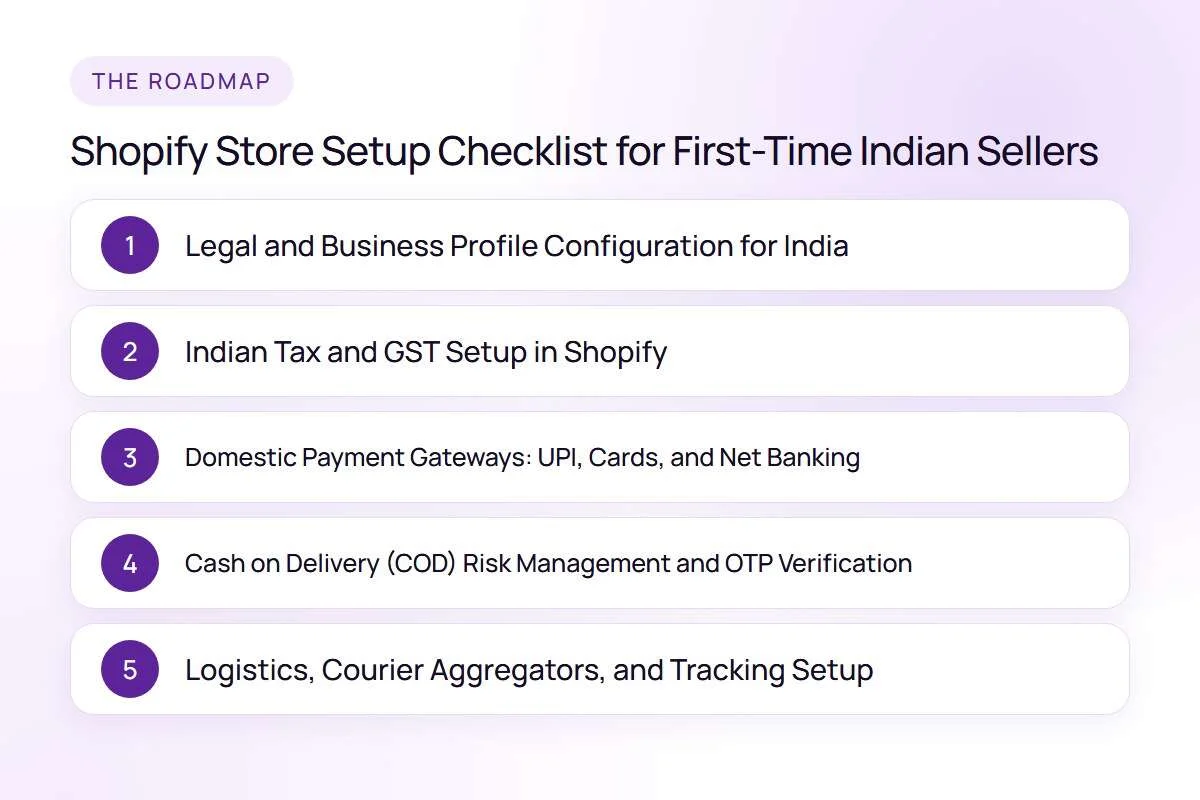
2. Indian Tax and GST Setup in Shopify
Configuring Indian Goods and Services Tax (GST) incorrectly can lead to accounting chaos and penalties. In India, e-commerce tax calculations depend on whether the transaction is intra-state (CGST + SGST) or inter-state (IGST).
Follow this step-by-step tax configuration:
- Navigate to Settings → Taxes and duties, and select India.
- Input your 15-digit GSTIN and specify your primary operating warehouse state.
- Configure your product prices to specify whether product catalogue prices are inclusive of tax or exclusive of tax. For Indian consumer retail, inclusive pricing is strongly recommended because sudden tax additions at checkout increase cart abandonment.
- Set Harmonised System of Nomenclature (HSN) codes for every product. This allows third-party invoicing applications to generate compliant tax invoices automatically upon order placement.
- If you sell across multiple tax slabs (such as 5%, 12%, 18%, or 28%), create custom collection tax overrides so Shopify calculates the exact tax percentage for each respective category.
3. Domestic Payment Gateways: UPI, Cards, and Net Banking
International payment gateways like standard PayPal or basic card forms fail to serve the Indian retail market effectively. More than seventy percent of online retail transactions in India are completed via UPI (Google Pay, PhonePe, Paytm, and BHIM). If your checkout does not offer a seamless, one-click UPI payment intent, you will lose the majority of your mobile traffic.
| Payment Solution | Integration Option | Primary Benefits for Indian Buyers |
|---|---|---|
| Razorpay / Cashfree | Native Shopify Payment App | Direct UPI intent, credit/debit cards, Net Banking across 50+ Indian banks, and automated refunds. |
| Cash on Delivery (COD) | Manual Payment Method | Essential for building initial trust; captures conservative buyers unfamiliar with new brands. |
| Instant EMI & Pay Later | Simpl / ZestMoney / Razorpay EMI | Increases average order value (AOV) on orders above ₹2,500 by spreading payments. |
| One-Click Checkout | GoKwik / Shopflo | Pre-fills addresses for 80M+ Indian buyers, dramatically shortening checkout friction. |
For merchants requiring bespoke checkout logic or custom subscription billing, our team develops tailored integrations through our Shopify store development services.
4. Cash on Delivery (COD) Risk Management and OTP Verification
While offering Cash on Delivery is essential to generate scale in Tier 2 and Tier 3 Indian cities, unmanaged COD can destroy your profitability through Return to Origin (RTO). When a customer refuses a COD parcel at their doorstep, you still pay forward and reverse shipping costs, resulting in an immediate loss of ₹120 to ₹250 per shipment.
Implement these three COD safeguards before turning on marketing campaigns:
- Automated Phone Number & OTP Verification: Use a verification tool to confirm the customer's mobile number via SMS or WhatsApp OTP before confirming a COD order. This eliminates fake addresses and bot orders instantly.
- Dynamic COD Surcharge: Add a modest convenience fee (such as ₹49 to ₹99) for COD orders while keeping prepaid orders free. This incentivises serious buyers to pay upfront via UPI.
- Address Quality Validation: Enforce full postal PIN code verification and require complete house, street, and landmark details to prevent couriers marking addresses as unlocatable.
5. Logistics, Courier Aggregators, and Tracking Setup
Fast and transparent shipping is a major competitive advantage in Indian e-commerce. Connecting your Shopify backend to domestic logistics aggregators automates manifest generation, courier allocation, label printing, and tracking alerts.
Key logistics steps for your launch checklist:
- Connect an Indian Shipping Aggregator: Integrate platforms like Shiprocket, Delhivery Direct, NimbusPost, or Pickrr via their official Shopify apps.
- Configure Serviceable PIN Codes: Upload a master PIN code list to prevent orders from remote areas where courier partners cannot deliver.
- Real-Time WhatsApp & SMS Tracking: Configure automated notification webhooks so customers receive instant tracking updates when their parcel is dispatched, out for delivery, or delayed.
- Return Logistics Workflow: Establish a clear reverse pickup protocol for customer exchanges and returns, ensuring inspected returns are processed smoothly back into your inventory.
Explore our broader ecommerce website development capabilities if your business requires hybrid multi-warehouse or WooCommerce architectures.
FAQs
Can an Indian seller launch a Shopify store without a GST registration?
Under current Indian e-commerce regulations, selling goods across state lines through e-commerce marketplaces and direct stores requires GST registration. While recent compositional exemptions exist for small intra-state turnover, obtaining a regular GSTIN is strongly advised to partner with shipping aggregators and payment gateways.
What is the average cost to run a Shopify store in India?
A starter Shopify plan costs approximately ₹1,999 per month (plus applicable GST). In addition, plan for payment gateway transaction charges (typically 1.8% to 2% + GST per transaction), domain renewal (around ₹900/year), logistics shipping expenses, and essential apps for invoicing and OTP verification.
How can a new brand reduce COD cancellations?
Call or WhatsApp first-time COD buyers to confirm their delivery availability before dispatching the order. Furthermore, provide an option to convert their COD order into a prepaid UPI order by offering an instant 5% discount via a payment link.
Which Indian payment gateway is best for beginners on Shopify?
Both Razorpay and Cashfree are excellent choices. They offer simple online onboarding, reliable uptime, competitive transaction fees, native support for all Indian UPI apps, and direct Shopify integration without custom programming.
Next Steps for Your Shopify Journey
Launching a successful Shopify store in India requires balancing intuitive visual design with disciplined operational execution. By securing your tax compliance, streamlining domestic payment options, and protecting your margins against COD returns, you establish a resilient e-commerce business ready for profitable growth.
If you are planning to launch a new D2C brand or want your existing online store audited by experienced e-commerce engineers, explore our specialised Shopify store development packages or get in touch with our team at IPrix Media.