
Google Business Profile Categories: How to Choose Correctly
A complete guide to choosing Google Business Profile categories: primary category ranking power, secondary category selection, and avoiding suspension traps.
By IPrix Media Team, web development and digital marketing company in Udaipur
In local search engine optimization (SEO), no single setting exerts a more immediate and powerful influence on your Google Maps rankings than your Google Business Profile (GBP) category selection.
You can upload hundreds of professional photos, collect dozens of five-star customer reviews, and build an immaculate corporate website, but if your primary Google Business Profile category is misaligned with the exact way local buyers search, your business will remain completely invisible in the competitive Google Local 3-Pack.
Thousands of local business owners unknowingly sabotage their own local discovery by selecting categories that are either too broad, factually inaccurate, or conflicting. A full-service digital agency selects "Internet Marketing Service" when seventy percent of their local market searches for "Website Designer". A luxury boutique hotel picks "Resort Hotel" when the dominant regional search volume revolves around "Heritage Hotel".
Small nuances in category selection often make the difference between appearing in the top three map positions across your city or being buried on page four where no customer ever looks.
This practical, research-backed guide walks local business owners and marketing managers through the exact methodology required to select the optimal primary category, utilize secondary categories strategically without diluting authority, and avoid common category mistakes that trigger profile suspensions.
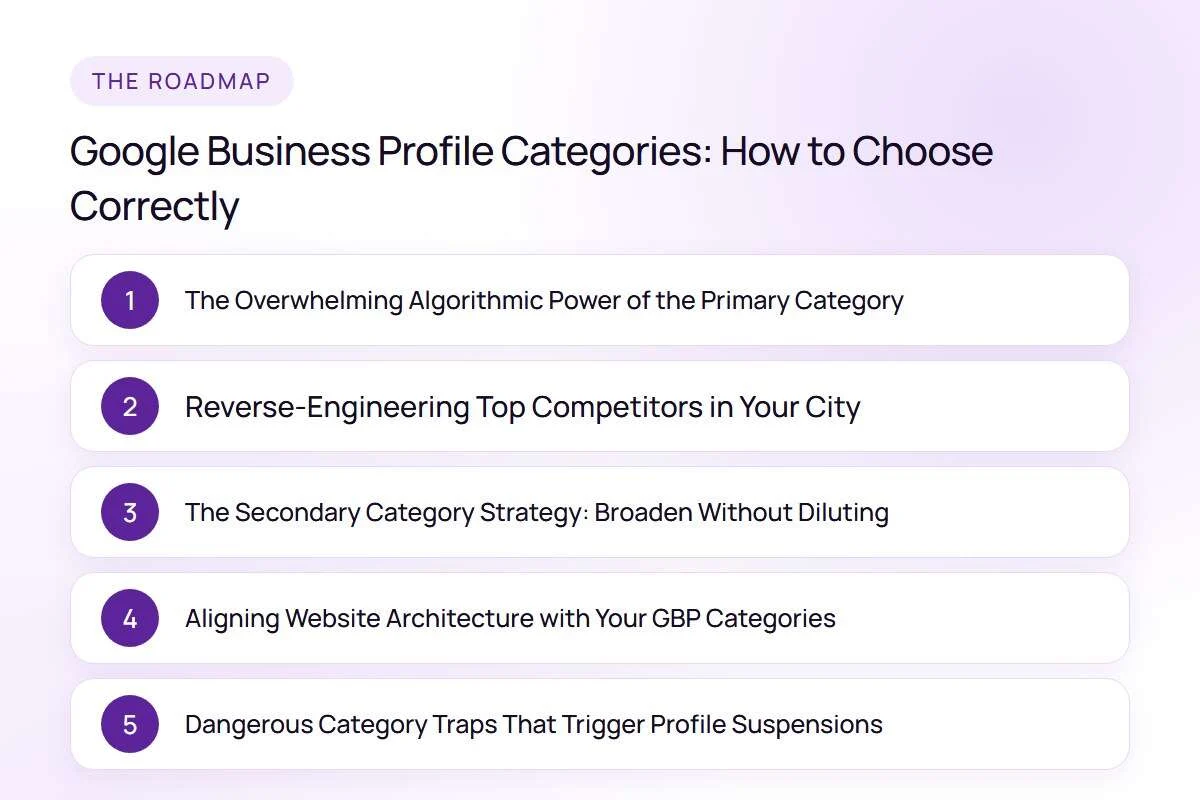
1. The Overwhelming Algorithmic Power of the Primary Category
Google maintains a master taxonomy of over four thousand standardized business categories. When a local user conducts a "near me" search or looks for a local service provider, Google's local ranking algorithm immediately filters the entire universe of local businesses based on their Primary Category.
Academic local search studies and real-world algorithmic testing consistently reveal that your Primary Category accounts for roughly sixty to eighty percent of your initial local ranking relevance.
Key principles governing the primary category:
- It is the Master Anchor: Your primary category tells Google what your business fundamentally is, not every incidental service you offer. A business can only have one primary category at any given time.
- It Unlocks Specific Profile Features: Google customizes your administrative dashboard based on your primary category. For instance, choosing "Hotel" unlocks room booking attributes and check-in times; choosing "Restaurant" unlocks online menu links; and choosing "Website Designer" unlocks detailed appointment booking fields and custom service menus.
- It Determines Local Pack Eligibility: If a user searches "custom software company in Udaipur", profiles with "Software Company" as their primary category will dominate the Local 3-Pack, while profiles that buried "Software Company" as their ninth secondary category will struggle to rank.
2. Reverse-Engineering Top Competitors in Your City
Never guess your primary category based on internal company titles or personal assumptions. You must discover the exact category that Google's algorithm already favors for your most valuable target keywords in your city.
Follow this simple 4-step competitor reverse-engineering process:
- Open an incognito browser window and search your highest-value commercial query (e.g., "digital marketing agency in Udaipur" or "commercial interior designer in Jaipur").
- Open the Google Maps Local 3-Pack view to display the top three ranking competitors.
- Inspect each competitor's listing: immediately underneath their business name, Google displays their assigned primary category in light grey text (e.g., "Website designer", "Marketing agency", or "Advertising agency").
- Note which primary category appears most frequently among the top three ranking listings. If all three top competitors share the exact same primary category, Google's algorithm has determined that this specific category has the strongest semantic intent for that search query.
For businesses looking to dominate local search across Rajasthan and India, our specialized digital marketing agency in Udaipur team conducts deep local competitive audits to position profiles for maximum discovery.
3. The Secondary Category Strategy: Broaden Without Diluting
While you can only select one primary category, Google allows you to select up to nine secondary categories. Secondary categories allow your business to appear for secondary service queries without weakening your primary focus.
However, selecting secondary categories requires discipline. A common mistake is selecting all nine allowed categories, including unrelated categories that confuse the algorithm. If a web design agency adds "Computer Repair Service" or "Photo Print Shop" as secondary categories simply because they own a printer, Google's algorithm struggles to understand the company's true core specialty.
Apply this strategic secondary category selection framework:
| Business Sector | Ideal Primary Category | Strategic Secondary Categories (3 to 5 Maximum) |
|---|---|---|
| Digital & Web Agency | Website Designer | Web Developer, Internet Marketing Service, Advertising Agency, Graphic Designer |
| Interior Design Firm | Interior Designer | Interior Decorator, Architectural Designer, Furniture Store, Kitchen Remodeler |
| Healthcare Clinic | Dentist (or core specialty) | Dental Clinic, Cosmetic Dentist, Teeth Whitening Service, Emergency Dental Service |
| Hospitality & Hotel | Hotel | Heritage Hotel, Resort Hotel, Restaurant, Banquet Hall |
| Industrial Manufacturer | Manufacturer | Industrial Equipment Supplier, Exporter, Fabrication Engineer |
In addition, ensure your broader domain authority reinforces these local categories by implementing our comprehensive SEO for sales growth frameworks.
4. Aligning Website Architecture with Your GBP Categories
Google does not evaluate your Google Business Profile in isolation. Its crawlers cross-reference the categories on your profile against the content, heading hierarchy, and structured data on the website linked to your listing.
If your primary category is "Website Designer", but the homepage of your linked website speaks exclusively about "Brand Strategy" and never mentions website design in its H1 or body text, Google detects an intent mismatch and deprioritizes your map ranking.
Ensure seamless alignment between your profile and website:
- Homepage H1 Alignment: Your homepage H1 should reflect your primary category (e.g., "Custom Website Design and Web Development Company in Udaipur").
- Dedicated Service Pages Matching Secondary Categories: Create dedicated landing pages on your website corresponding to each secondary category. If "Internet Marketing Service" is a secondary category, maintain a dedicated
/digital-marketing-services/page. - LocalBusiness Schema Markup: Embed clean JSON-LD structured data on your website specifying the
@typethat matches your primary category (e.g.,"@type": "ProfessionalService"or"@type": "LocalBusiness").
5. Dangerous Category Traps That Trigger Profile Suspensions
Google's spam prevention algorithms closely monitor category edits. Careless category manipulation can trigger sudden profile soft suspensions or require mandatory video re-verification.
Avoid these critical compliance pitfalls:
- Never Change Primary Categories Frequently: Switching your primary category back and forth every few weeks confuses the algorithm, wipes out accumulated ranking history, and frequently triggers an automated profile suspension. Choose a well-researched primary category and maintain it for at least six months.
- Never Select Categories That Require Licensing You Do Not Possess: Selecting regulated categories (such as legal, medical, or financial consultancies) requires verifiable regulatory licenses.
- Avoid Seasonal Category Flipping: Flipping your category seasonally (e.g., switching from "Landscaping" to "Snow Removal") is risky. Instead, maintain your core category and use secondary categories and seasonal posts to announce temporary offerings.
FAQs
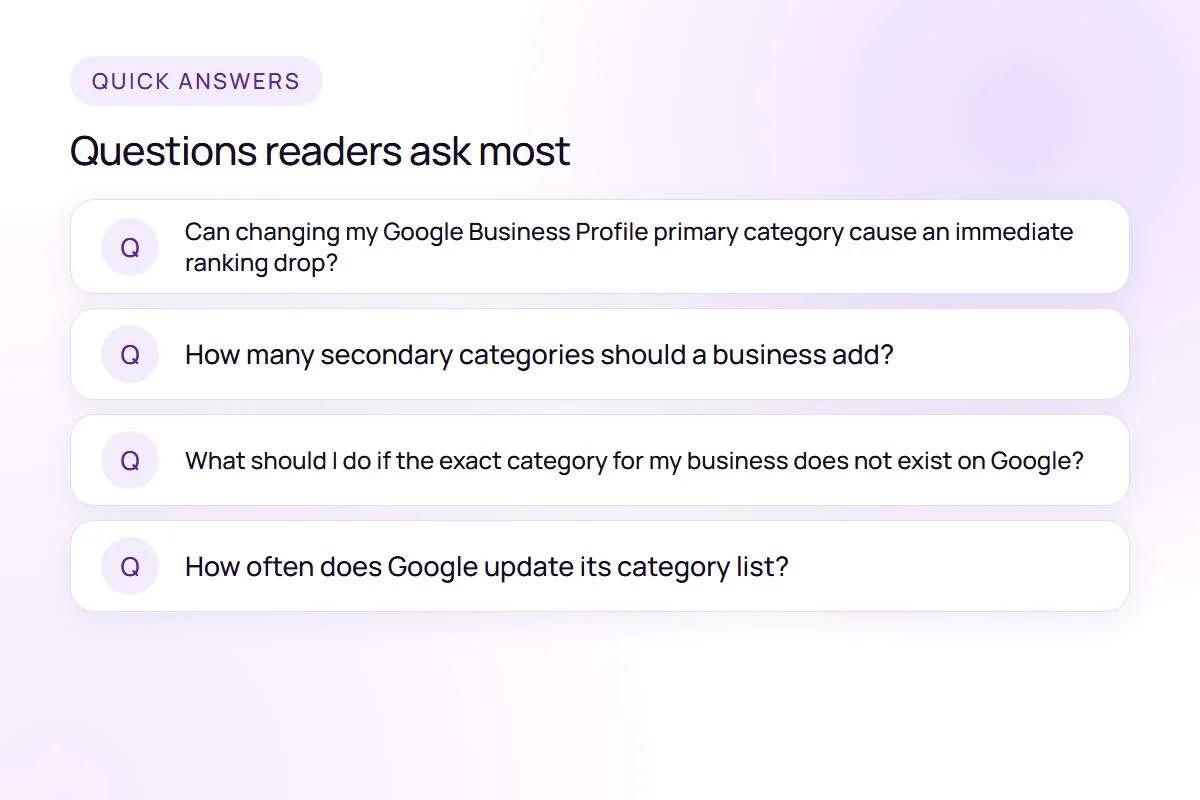
Can changing my Google Business Profile primary category cause an immediate ranking drop?
Yes. Changing your primary category will instantly reset your ranking relevance for your previous keywords. While you will gain immediate visibility for queries matching your new category, ensure that the new category possesses higher commercial search demand before executing the change.
How many secondary categories should a business add?
More is not better. Selecting 3 to 5 highly relevant, closely related secondary categories is the industry standard. Adding unrelated categories dilutes your profile's topical authority and suppresses your primary rankings.
What should I do if the exact category for my business does not exist on Google?
Google's category taxonomy is fixed; you cannot type in a custom category name. If your exact niche is not listed, choose the closest, most specific parent category available (e.g., choose "Marketing Agency" if "Social Media Marketing Agency" is unavailable), and detail your specific sub-services in your custom Services menu.
How often does Google update its category list?
Google adds, renames, and deprecates categories several times a year. Audit your category settings twice a year to ensure your profile utilizes any newly introduced, more specific categories that match your business offerings.
Next Steps for Your Local Search Dominance
Selecting the correct Google Business Profile categories is the highest-leverage optimization you can perform for local customer discovery. By anchoring your profile with a dominant primary category, utilizing secondary categories with discipline, and aligning your website architecture with your local listing, you unlock consistent visibility in the Google Local 3-Pack.
If your business needs a comprehensive local search audit, profile optimization, or aggressive multi-location expansion across India, explore our specialized digital marketing agency in Udaipur services or contact IPrix Media today.