AI Search Brand Discovery: How It Changes
Explore how AI search, Google AI Overviews, ChatGPT, and Perplexity are reshaping brand discovery, and learn practical frameworks for Answer Engine.
By IPrix Media Team, web development and digital marketing company in Udaipur
The way buyers find, evaluate, and choose businesses online is undergoing the most significant transformation since Google launched its first search engine. For more than two decades, search engine optimization meant competing for ten blue links on a results page. Today, millions of prospective buyers bypass traditional keyword searches entirely. Instead, they ask complex, multi-sentence questions directly to conversational AI engines—such as Google AI Overviews, ChatGPT Search, Perplexity AI, and Microsoft Copilot.
When a prospective buyer asks, "What are the most reliable B2B web development companies in Western India with proven experience in Shopify and custom web apps?", the AI assistant does not deliver a list of ten arbitrary links. It synthesizes information across dozens of indexed sources, generates a direct conversational answer, and cites three or four authoritative brands as trusted recommendations. If your brand is not structured for this new paradigm, your business becomes invisible at the exact moment purchase decisions are made.
This comprehensive guide breaks down how AI search works, what Answer Engine Optimization (AEO) and Generative Engine Optimization (GEO) actually mean for business owners, and the practical steps your company must take to earn trusted citations in conversational search engines.
1. The Shift from Keyword Queries to Conversational Intent
Traditional search engines operate on keyword matching: a user types "best digital marketing agency Udaipur", and the algorithm retrieves pages containing those exact phrases and authoritative backlinks. Conversational AI search engines operate on large language models (LLMs) and retrieval-augmented generation (RAG). They analyze the user's intent, synthesize context from multiple web sources in real time, and format a cohesive answer.
This fundamental shift alters buyer behavior in three critical ways:
- Zero-Click Informational Searches: For simple factual questions ("What is the difference between Shopify and WooCommerce?"), AI engines answer the user immediately on the results screen. Traditional informational click-through rates are declining, meaning generic definition-style blog posts bring diminishing commercial value.
- High-Intent Synthesis at the Decision Stage: When buyers ask comparison or evaluation questions, they rely on AI summaries to shortlist vendors. Being cited as a verified source within an AI summary carries immense credibility—acting like a direct personal recommendation from an objective expert.
- Entity-First Verification: AI models do not evaluate pages in isolation. They evaluate your entire brand entity—looking at your official website, customer reviews, third-party directory profiles, press mentions, and social consensus to determine whether your business is reputable.
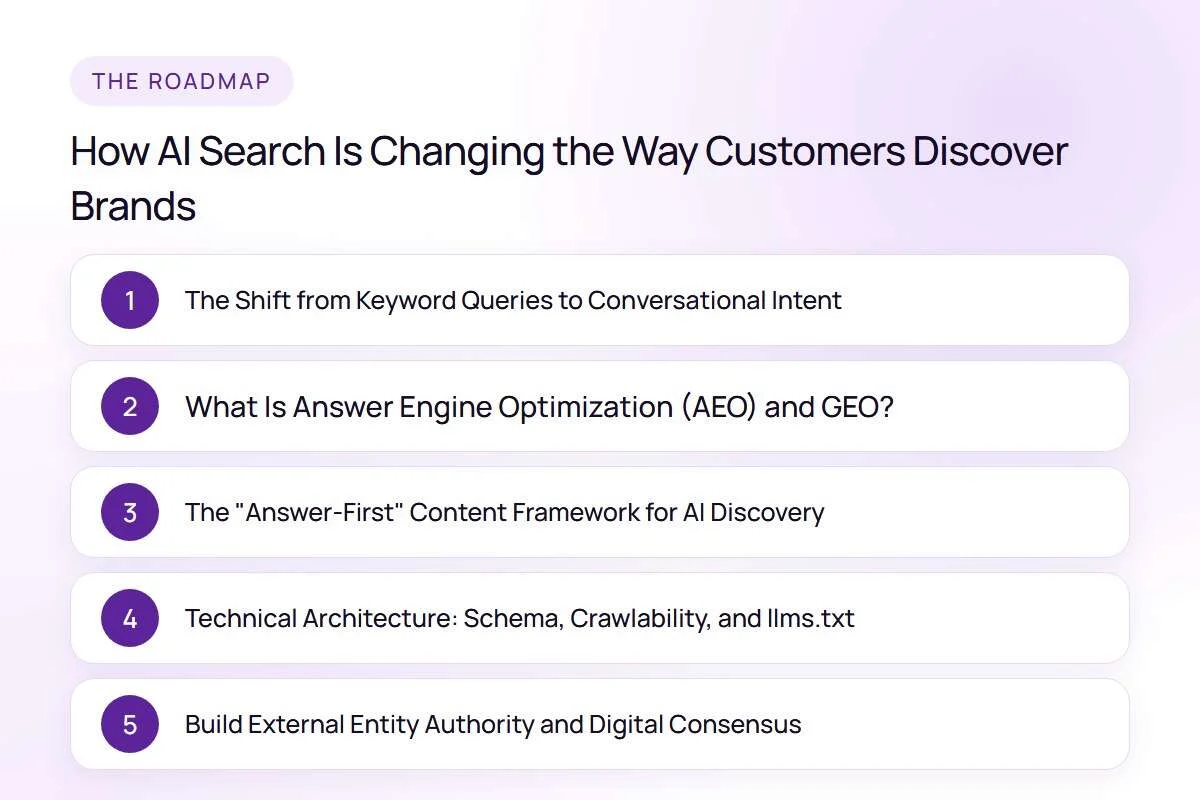
2. What Is Answer Engine Optimization (AEO) and GEO?
Answer Engine Optimization (AEO) and Generative Engine Optimization (GEO) refer to the strategic practice of engineering your digital content and brand signals so AI systems can easily extract, comprehend, verify, and cite your answers.
Where traditional SEO focuses on winning clicks, AEO focuses on becoming the authoritative source that language models quote when answering buyer questions.
| SEO Dimension | Traditional Organic SEO | Answer Engine Optimization (AEO / GEO) |
|---|---|---|
| Primary Goal | Top 3 rank in 10 blue links; organic click-through | Direct quote or source citation within AI generated summaries |
| Search Query Style | Short keywords ("web development agency") | Natural conversational questions ("Which agency builds fast Shopify sites?") |
| Content Formatting | Long-form articles with repeated keywords | "Answer-First" concise summaries followed by structured frameworks |
| Key Ranking Signals | Page backlinks, exact keywords, domain authority | Entity clarity, brand sentiment, schema markup, factual consensus |
| Primary Platforms | Google, Bing | Google AI Overviews, Perplexity, ChatGPT Search, Claude, Copilot |
To help growing enterprises adapt their search strategy to these emerging technologies, our agency provides specialized AI SEO services designed for conversational search visibility.
3. The "Answer-First" Content Framework for AI Discovery
Large language models are trained to extract concise, factually dense information that can be quickly cited in real-time answers. If your website hides its answers behind long, meandering introductions filled with generic platitudes, AI crawlers will skip your content in favor of a source that delivers immediate clarity.
To maximize your chances of being cited by AI search engines, structure every key informational and commercial section using the Answer-First Framework:
- Question-Based Heading: Formulate your H2 and H3 headings exactly as buyers speak: "How much does custom website development cost in India?", "What are the security risks of shared WordPress hosting?"
- Direct 40-to-60 Word Direct Answer: Immediately underneath the heading, provide a clear, unambiguous answer in plain English. State the core takeaway, price range, or diagnostic rule in the very first sentence.
- Structured Supporting Data: Follow the direct answer with a clean bulleted checklist or a comparison table that elaborates on the technical details. Tables and bulleted lists are exceptionally easy for LLMs to parse and quote accurately.
- Original First-Party Perspective: Provide an original observation, real project milestone, or proprietary framework that exists nowhere else on the web. AI engines prioritize sources that contribute unique value rather than regurgitating common consensus.
4. Technical Architecture: Schema, Crawlability, and llms.txt
Technical health remains the bedrock of AI discovery. If search engine bots encounter crawl barriers, unrendered JavaScript, or ambiguous entity data, they cannot index your content into their retrieval systems.
Ensure your website implements these essential technical standards:
- Comprehensive JSON-LD Entity Schema: Use clean, validated structured data to explicitly define who you are. Implement Organization schema linking your official social profiles, Service schema defining your commercial offerings, and FAQPage schema matching your visible on-page answers. Structured data allows language models to map your brand entity into their knowledge graphs with high confidence.
- Fast Server-Side Rendering: If your website relies on heavy client-side JavaScript that takes seconds to render in a headless browser, AI search crawlers may fail to parse the full text. Ensure all critical content is rendered in clean server-side HTML.
- Publish an
llms.txtFile: Likerobots.txtguides web crawlers, the emergingllms.txtstandard provides AI scrapers with a clean markdown overview of your brand's core pages, offerings, and direct answers, facilitating accurate ingestion.
Explore our comprehensive SEO for sales growth framework to understand how technical schema and core web vitals integrate with modern content architecture.
5. Build External Entity Authority and Digital Consensus
AI language models do not take your website's self-promotional claims at face value. To verify whether your company is truly an industry leader, they cross-reference what the wider web says about you across independent third-party sources.
To build powerful digital consensus:
- Earn Legitimate Third-Party Reviews: Consistent positive reviews on Google Business Profile, Clutch, GoodFirms, and Trustpilot reinforce entity trust. When an AI evaluates recommendations, high review sentiment across multiple independent platforms is a primary selection filter.
- Industry Directory Accuracy: Ensure your company name, physical address, leadership team, and service descriptions are identical across all public corporate registers and business directories.
- Digital PR and Expert Mentions: Contribute thoughtful industry commentary, guest articles, and case study breakdowns to reputable business publications. When external publications mention your brand in connection with specific technical topics, AI models associate your entity with that domain of expertise.
FAQs
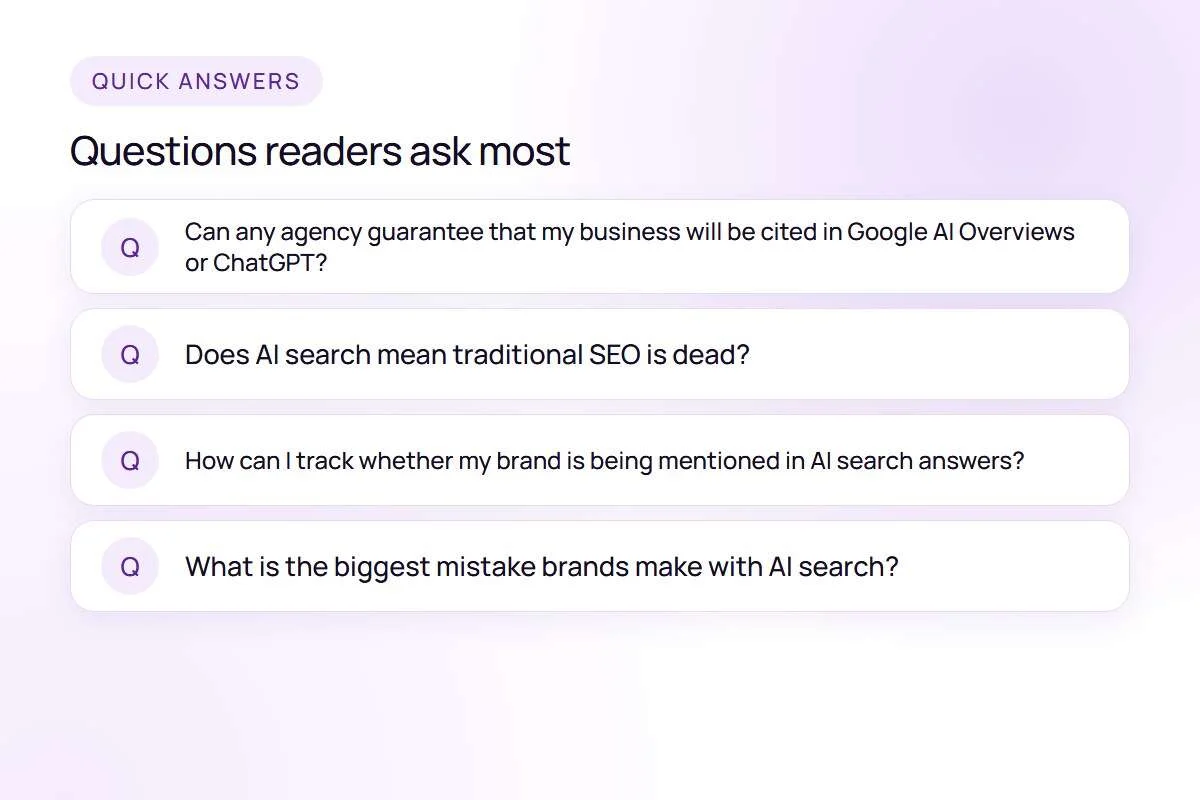
Can any agency guarantee that my business will be cited in Google AI Overviews or ChatGPT?
No reputable agency can guarantee AI citations. Language model outputs are probabilistic and constantly evolve based on user context, query phrasing, and algorithmic updates. Any agency promising guaranteed AI placement is making false claims. The legitimate approach is building high-quality, answer-first content backed by strong entity authority and technical schema.
Does AI search mean traditional SEO is dead?
Traditional SEO is not dead; it is evolving. AI engines rely directly on traditional search indexes (such as Google and Bing) to retrieve source documents in real time. Passing Core Web Vitals, maintaining clean crawlability, earning authoritative links, and matching search intent remain the foundation upon which AI discovery operates.
How can I track whether my brand is being mentioned in AI search answers?
Monitor your branded search volume in Google Search Console, watch for referral traffic from sources like android-app://com.openai.chat or perplexity.ai, and regularly query major AI assistants with your target commercial questions to observe brand mentions and cited URLs.
What is the biggest mistake brands make with AI search?
The biggest mistake is flooding their website with hundreds of low-quality, automated AI-generated articles. AI search engines are engineered to prioritize original human expertise, real client data, and verified entity trust. Thin, generic content is ignored by both humans and AI answer engines.
Next Steps for Your Brand in the AI Era
The rise of conversational AI search does not diminish the value of a strong digital presence; it raises the bar for quality, clarity, and genuine authority. Businesses that adapt by structuring their pages for answer extraction, proving real client outcomes, and maintaining pristine technical foundations will dominate commercial brand discovery in this new era.
If your company is ready to prepare its website for the future of search and capture high-intent buyers across both Google and AI search engines, explore our advanced AI SEO services or contact IPrix Media for a strategic consultation today.