How to Make Service Pages Easier for AI Search Tools to Understand
A technical guide to making commercial service pages understandable for AI search engines: entity clarity, answer-first content, JSON-LD schema, and llms.txt.
By IPrix Media Team, web development and digital marketing company in Udaipur
As conversational artificial intelligence search engines—such as Google AI Overviews, Perplexity AI, ChatGPT Search, and Claude—become primary channels for commercial discovery, the technical requirements for website content have fundamentally changed.
For the past twenty years, search engine crawlers acted primarily like keyword indexers. If your service page included the phrase "custom web application development" five times in prominent headings and had strong backlinks, search engines matched your URL to the query.
Conversational AI search tools, however, operate on large language models (LLMs) and retrieval-augmented generation (RAG). They do not simply scan for keyword density; they read, parse, extract, evaluate, and synthesize information to answer complex multi-part buyer questions in real time.
If your commercial service page hides its core deliverables behind ambiguous marketing metaphors, meanders through four paragraphs of corporate poetry before explaining what you build, or buries pricing structures in unstructured text, AI search crawlers cannot extract clear answers. When an AI tool cannot extract verified facts from your content with high algorithmic confidence, it simply ignores your company and cites a competitor whose pages are structured for effortless machine comprehension.
Making your service pages easy for AI search tools to understand—the core discipline of Answer Engine Optimization (AEO) and Generative Engine Optimization (GEO)—requires a synchronized blend of semantic HTML architecture, entity-based structured schema, answer-first copywriting, and machine-readable summaries.
This technical guide details the exact steps your business must implement to make your commercial service pages pristine, authoritative, and citation-ready for conversational search engines.
1. Adopt the "Inverted Pyramid" Answer-First Heading Structure
Large language models are computationally expensive. When an AI search engine processes search queries, its retrieval models prioritize web documents that deliver immediate, unambiguous semantic clarity. Pages with meandering, long-winded introductions are frequently discarded during the initial retrieval filtering phase.
To ensure AI crawlers identify your page as an authoritative source, organize every major service section using the Inverted Pyramid Framework:
- Question-Based H2: Write headings that match buyer questions: "What is included in custom web application development?"
- The Direct 40-to-60 Word Core Answer: Underneath the heading, provide a complete factual answer in the first sentence without introductory filler: "Custom web application development includes bespoke UI/UX prototyping, frontend architecture, backend database development, third-party API integration, and automated testing."
- Structured Elaboration (Lists and Tables): Follow with clean bulleted lists or comparison tables, which LLMs parse far more accurately than dense unstructured paragraphs.
- Contextual First-Party Evidence: Conclude the section with an original observation from real project experience, establishing genuine expertise.
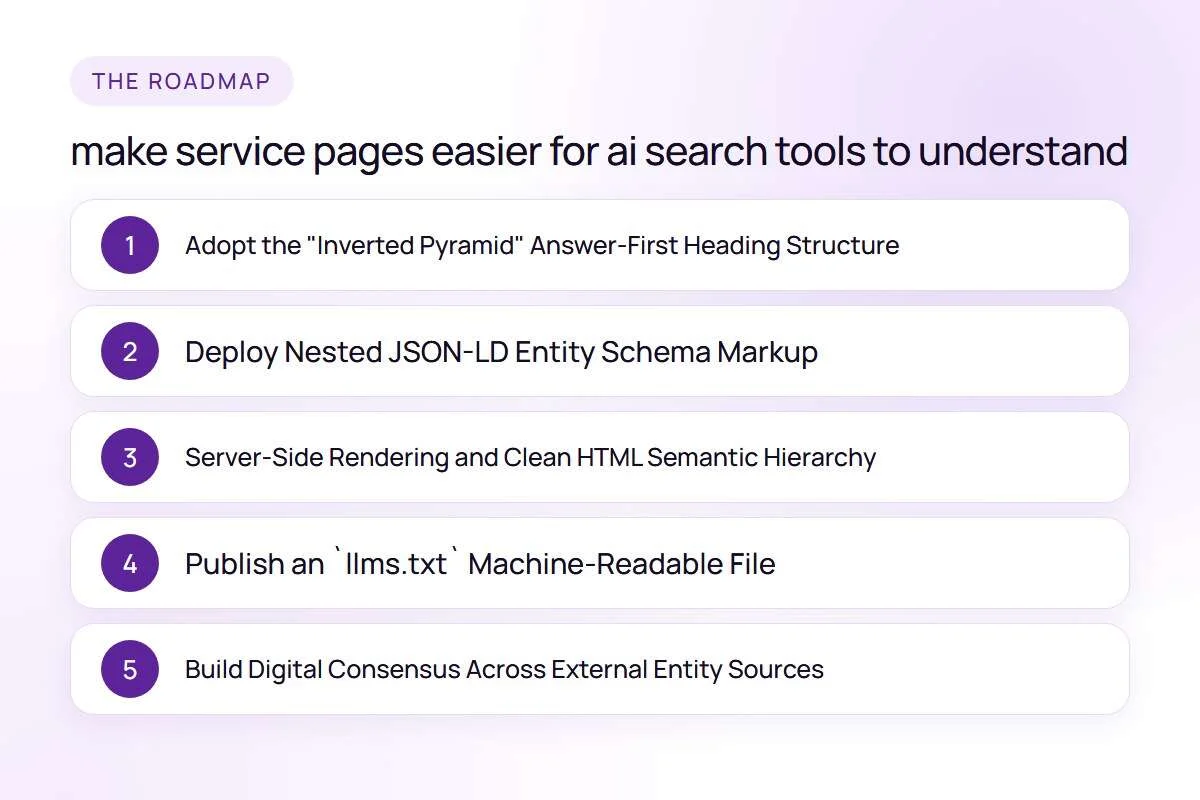
2. Deploy Nested JSON-LD Entity Schema Markup
While modern AI models are adept at reading human text, structured data (JSON-LD) remains the most unambiguous language you can provide to machine crawlers. Structured data acts like an explicit instruction manual that tells search engines exactly who you are, what service you deliver, and what terms apply to your offering.
For commercial service pages, do not settle for basic Article schema. Implement comprehensive, nested schema containing these three layers:
| Schema Layer | JSON-LD @type |
Strategic Purpose for AI Search Comprehension |
|---|---|---|
| Entity Identity | Organization / LocalBusiness |
Connects your official business name, registered address, logo, and verified social profiles. |
| Commercial Offering | Service |
Defines the specific service name, provider, area served, service type, and description. |
| Extracted Answers | FAQPage |
Pairs on-page question headings and concise answers into machine-readable Q&A nodes. |
Crucially, ensure that the visible text on your webpage matches your JSON-LD schema markup identically. Injecting hidden schema content that does not appear visually to human visitors violates Google's structured data guidelines and can trigger algorithmic penalties.
For businesses looking to engineer high-authority AI visibility, explore our specialized AI SEO services and entity optimization programs.
3. Server-Side Rendering and Clean HTML Semantic Hierarchy
Many modern web developers build websites using heavy client-side JavaScript frameworks (such as Single Page Applications built in React or Vue without server-side rendering). While these platforms look smooth to human users, they can be disastrous for search crawlers.
When an AI search engine retrieves content in real time to generate an answer, its retrieval bots operate under strict time limits (often under 800 milliseconds). If your page requires complex client-side JavaScript execution to render text into the Document Object Model (DOM), the AI scraper may experience a rendering timeout and read an empty page.
Ensure your technical architecture enforces these standards:
- Fast Server-Side Rendering (SSR): Ensure all core service text, headings, and tables are fully rendered in raw server-side HTML before reaching the browser.
- Strict Heading Hierarchy: Maintain exactly one
<h1>per page reflecting the primary service. Ensure<h2>tags represent major sub-topics, and<h3>tags are used strictly for subordinate points. Never use heading tags purely for visual styling. - Explicit Content Containers: Wrap your main service content in semantic HTML5
<main>,<article>, and<section>tags. This allows web parsers to distinguish primary editorial text from navigation menus and footer boilerplates instantly.
In addition, ensure your site passes Core Web Vitals thresholds by implementing our technical website speed optimization frameworks.
4. Publish an llms.txt Machine-Readable File
An exciting, rapidly emerging standard for AI search discovery is the llms.txt file. Similar to how robots.txt instructs traditional search crawlers on crawl permissions, an llms.txt file provides language models with a clean, Markdown-formatted summary of your company's core services, primary offerings, and verified facts.
By publishing an llms.txt file at the root of your domain (yourdomain.com/llms.txt), you provide AI crawlers with an authoritative, curated source of truth that language models can digest in milliseconds without parsing complex web layouts.
Structure your llms.txt file to include:
- Clear Brand Summary: A single paragraph summarizing your company, founding location, and primary commercial expertise.
- Core Service Directory: Direct links to your primary service pages, accompanied by a 2-sentence summary of each service's target audience and key deliverables.
- Verified Entity Credentials: Office address, leadership team, verified client project counts, and official external profiles (such as Google Business Profile and LinkedIn).
Explore our broader SEO for sales growth frameworks to see how machine-readable assets integrate with broader organic search campaigns.
5. Build Digital Consensus Across External Entity Sources
Language models do not rely solely on what your website claims about itself. When evaluating whether to cite your service page as a recommended solution, an AI engine evaluates digital consensus—what independent external sources say about your company.
To build powerful external validation:
- NAP and Entity Consistency: Ensure your company name, physical address, and phone number are identical across all directories, press releases, and corporate registries.
- Third-Party Review Sentiment: High volumes of detailed, positive reviews on independent platforms (Google Business Profile, Clutch, GoodFirms) reinforce to language models that your service is trusted by real clients.
- Authoritative Mentions and Backlinks: Earn natural editorial mentions in reputable trade publications. When high-authority websites mention your brand in context with specific service keywords, AI models map your entity into their knowledge graphs with immense confidence.
FAQs
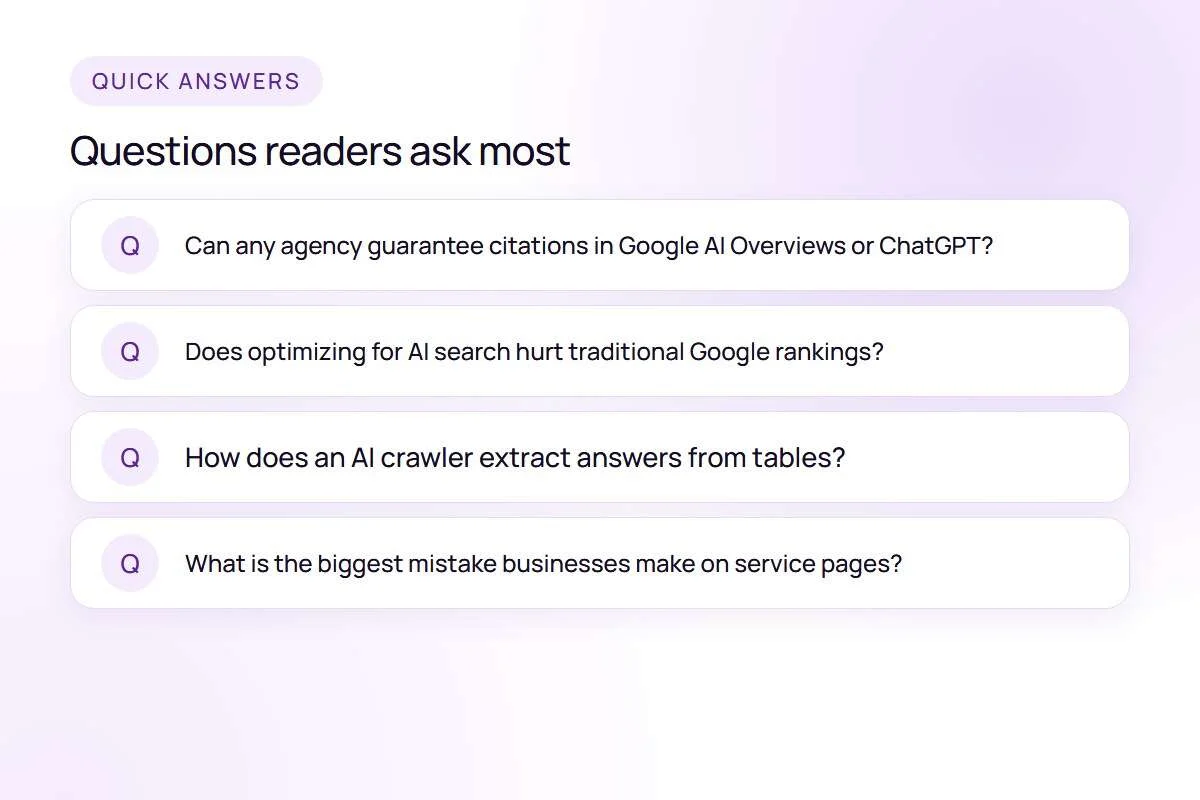
Can any agency guarantee citations in Google AI Overviews or ChatGPT?
No. Anyone promising guaranteed AI search citations is making false claims. Language models generate answers dynamically based on real-time query semantics and probabilistic scoring. The legitimate approach is maximizing machine comprehension through structured data, clean HTML, and undisputed entity authority.
Does optimizing for AI search hurt traditional Google rankings?
Not at all. In fact, optimizing for AI comprehension significantly improves traditional SEO. Both AI search engines and traditional search algorithms prioritize clear headings, fast server-side loading, structured schema, and concise answers that satisfy user intent.
How does an AI crawler extract answers from tables?
AI models excel at extracting data from clean HTML <table> structures. When you format data into simple rows and columns with explicit <th> header tags (such as pricing comparisons or feature breakdowns), language models can extract and cite exact data points with near-perfect accuracy.
What is the biggest mistake businesses make on service pages?
The most frequent mistake is using abstract corporate jargon that explains nothing. Writing "We synergize bespoke omnichannel experiences" tells an AI model zero factual information. Writing "We design and build custom WordPress and Shopify websites for Indian businesses" gives the machine clear semantic facts to index and cite.
Next Steps for Your AI Search Readiness
The evolution of search from keyword matching to conversational answer generation represents a massive opportunity for businesses that act early. By structuring your service pages with answer-first copywriting, nesting comprehensive JSON-LD schema, ensuring fast server-side rendering, and publishing machine-readable summaries, you ensure your business is prominently cited at the forefront of the AI era.
If your company wants to audit its web architecture for conversational AI readiness or implement comprehensive Answer Engine Optimization, explore our specialized AI SEO services or contact IPrix Media for an architectural consultation today.