How to Find Keywords That Can Bring Paying Customers
Learn how to find high-intent commercial keywords that drive paying customers: search intent mapping, long-tail qualifiers, and Google Search Console data.
By IPrix Media Team, web development and digital marketing company in Udaipur
One of the most persistent and costly misconceptions in search engine optimization (SEO) is assuming that high search volume automatically translates into high business revenue. Business owners frequently celebrate when a blog post ranks number one on Google for a broad informational phrase that attracts fifty thousand monthly readers. Yet, at the end of the quarter, the sales team looks at an empty pipeline because not a single one of those fifty thousand visitors had an active budget or an intention to buy.
Chasing high-volume vanity keywords is like setting up a luxury retail storefront in the middle of a highway: millions of people zoom past, but nobody is stopping to shop.
If your goal is generating qualified leads, booked client calls, and paying e-commerce customers, your SEO strategy must pivot from raw search volume to commercial search intent. You must identify the exact, specific phrases buyers type into Google at the exact moment they have a credit card in hand or an approved corporate purchase order on their desk.
This comprehensive guide outlines a tested, step-by-step keyword research methodology engineered specifically for business owners, service firms, and marketing managers to discover high-converting, bottom-of-the-funnel keywords that turn organic search traffic into measurable revenue.
1. Deconstructing Search Intent: The Four Keyword Categories
Search engines evaluate every query through the lens of user intent. To find keywords that generate sales, you must understand the four distinct categories of search queries and know which ones produce revenue:
- 1. Informational Intent (Top of Funnel): The user is seeking knowledge or learning a concept (e.g., "What is digital marketing?", "History of WordPress", "How does a solar panel work?"). These users are students, researchers, or casual browsers with zero immediate intention to hire an agency.
- 2. Navigational Intent: The user knows the exact brand and wants to reach their site (e.g., "Shopify login", "IPrix Media contact").
- 3. Commercial Investigation Intent (Middle of Funnel): The user has recognized a problem, has allocated a budget, and is comparing specific solutions, providers, or pricing models (e.g., "Best web development company in Udaipur", "Shopify vs WooCommerce cost comparison", "SEO packages in India").
- 4. Transactional Intent (Bottom of Funnel): The user is ready to buy or hire immediately (e.g., "Hire custom WordPress developer", "Emergency Shopify bug fix service", "Buy 925 silver ring online").
To build an organic acquisition engine that produces clients, at least eighty percent of your initial SEO effort must be focused on Commercial Investigation and Transactional queries.
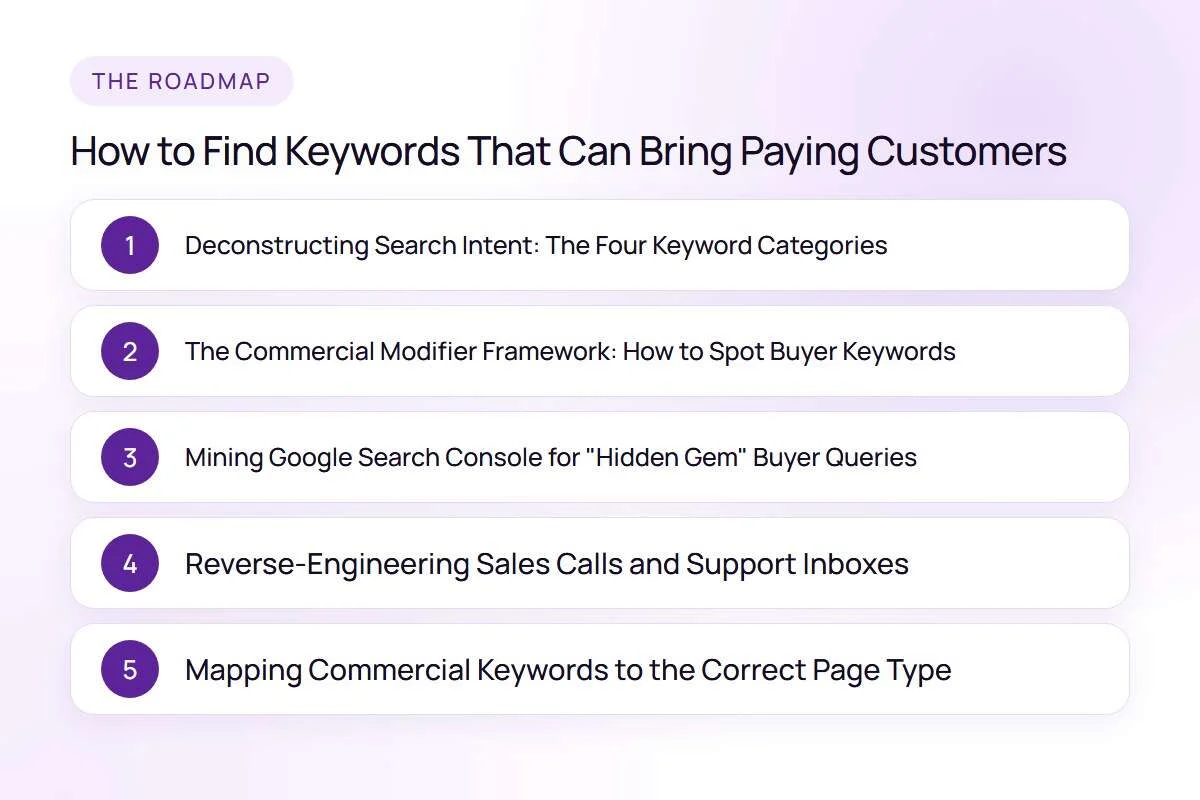
2. The Commercial Modifier Framework: How to Spot Buyer Keywords
Commercial keywords possess specific grammatical modifiers that signal purchase intent. When a searcher adds one of these modifiers to a core service word, their likelihood of converting into a paying client increases tenfold.
Systematically apply these high-intent keyword modifiers to your core offerings:
| Intent Modifier Category | Keyword Formula / Examples | Why It Converts Into Paying Clients |
|---|---|---|
| Location & Proximity | [service] in [city] / "interior designer in Udaipur" |
High geographical intent; the buyer wants an accountable local partner. |
| Vendor & Agency Modifiers | [service] agency / company / firm / specialist |
Pre-qualifies the user as someone looking to hire an external professional team. |
| Pricing & Cost Queries | [service] cost / pricing / packages / quote |
Indicates the buyer has budget approval and is actively building a financial business case. |
| Comparison & Alternatives | [Platform A] vs [Platform B] for [industry] |
High-consideration buyers choosing between two specific platforms before signing a contract. |
| Action & Service Modifiers | hire / outsource / audit / migration service |
High transactional urgency; the client has an immediate project ready to execute. |
When creating content targeting these phrases, integrate natural contextual links to your primary service solutions, such as our specialized SEO for sales growth capabilities.
3. Mining Google Search Console for "Hidden Gem" Buyer Queries
The single most accurate source of buyer keyword data is not third-party estimation software; it is your own Google Search Console (GSC) account. GSC reveals the exact real-world search phrases that real users type to find your website, including queries where you currently rank on page 2 or page 3.
Follow this 4-step GSC query mining process:
- Open Google Search Console and navigate to Search Results under the Performance tab.
- Select a date range of the last 6 months, and check the boxes for Total Clicks, Total Impressions, and Average Position.
- Apply a query filter containing commercial modifiers: filter for queries containing words like
"cost","service","company","agency","hire", or"pricing". - Identify queries with high impressions (indicating healthy demand) but an average position between 8 and 20. These are your "Hidden Gems"—queries where Google already considers your site relevant, but your page needs dedicated content refinement, heading optimization, or internal links to push it onto page 1.
4. Reverse-Engineering Sales Calls and Support Inboxes
The most profitable keywords often never appear in traditional keyword research tools because commercial search volumes are low (e.g., 50 searches per month). However, those 50 searches represent 50 high-ticket corporate decision-makers looking for a specialized solution.
To uncover these un-tapped buyer phrases, interview your sales team and review your client inquiry emails:
- What exact questions do prospects ask on introductory sales calls? (e.g., "How long does it take to migrate a custom PHP store to Shopify without losing SEO rankings?")
- What specific pain points led them to reach out? (e.g., "Our WordPress website crashed after a WooCommerce update and our agency isn't responding.")
- What specific integrations or technologies do they require? (e.g., "Do you build custom Razorpay webhook integrations for veterinary booking portals?")
Every single one of these real-world questions represents a high-converting long-tail keyword that should be developed into a dedicated, deep-dive service guide.
In addition, ensure your underlying technical infrastructure supports rapid crawling and indexing by reviewing your website speed optimization foundations.
5. Mapping Commercial Keywords to the Correct Page Type
Finding high-intent keywords is only half the battle; you must map each keyword to the appropriate page format. A common mistake is targeting a transactional buyer keyword with a generic informational blog post, or conversely, targeting an educational query with a hard-sell sales page.
Follow this structural mapping rule:
- Broad Commercial Category Keywords (e.g., "custom website design India"): Map to your primary Core Service Hub Pages.
- Specialized Niche Service Keywords (e.g., "Shopify app development for subscription billing"): Map to dedicated Secondary Service Landing Pages.
- Geographic Local Keywords (e.g., "digital marketing agency in Udaipur"): Map to City-Specific Service Landing Pages.
- Comparison and Pricing Keywords (e.g., "website development cost in India price guide"): Map to detailed Commercial Editorial Guides and Calculators.
FAQs
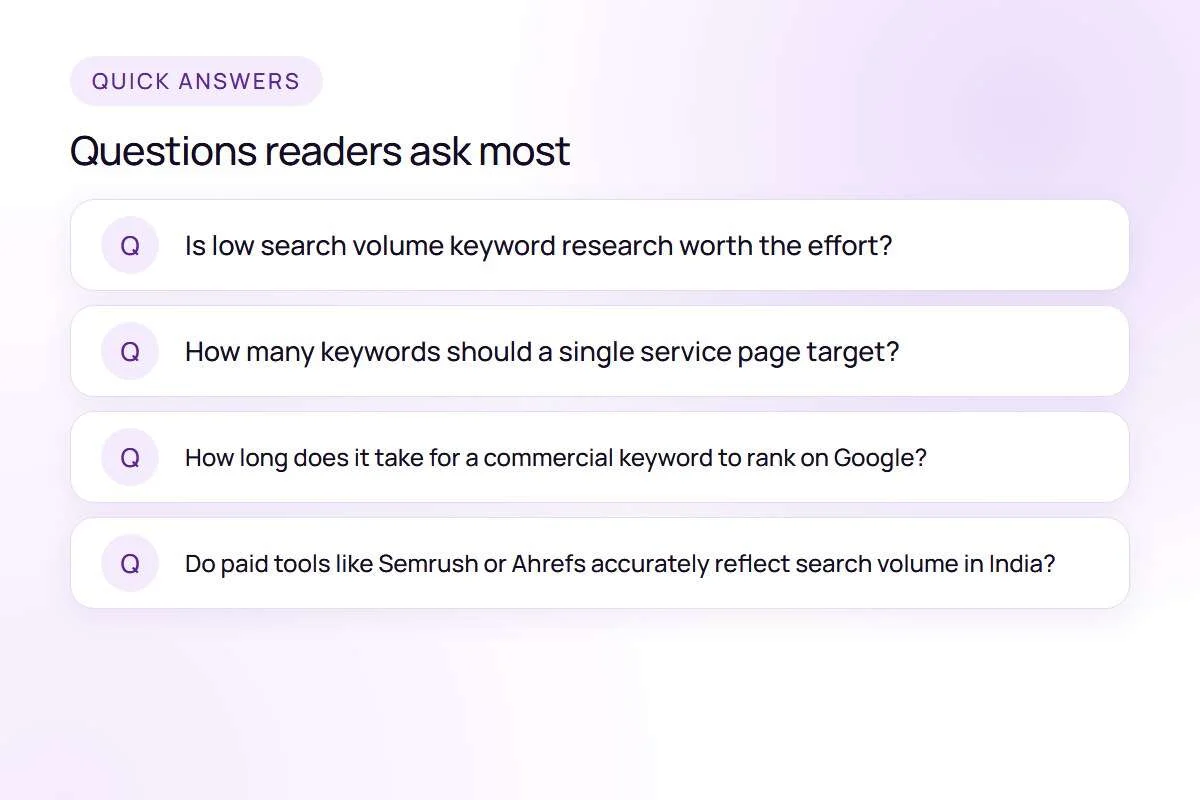
Is low search volume keyword research worth the effort?
Yes. In B2B and high-ticket service industries, a keyword with only 30 monthly searches can generate three enterprise inquiries worth lakhs of rupees. Target audience relevance and commercial purchase intent are infinitely more valuable than raw search volume.
How many keywords should a single service page target?
A well-structured service page should target one primary commercial keyword (such as "custom website design") supported by 4 to 8 natural semantic variations and long-tail questions (such as "bespoke web design company", "professional website design cost", "responsive web design agency").
How long does it take for a commercial keyword to rank on Google?
For low to medium-competition long-tail keywords on a website with clean technical health and active content relevance, ranking improvements typically appear within 6 to 12 weeks. Broad, national high-competition keywords often require 4 to 8 months of consistent domain authority building.
Do paid tools like Semrush or Ahrefs accurately reflect search volume in India?
Third-party tools rely on data sampling and clickstream estimation models, which frequently underestimate niche B2B search volumes in India. Use paid tools for directional keyword ideation, but rely primarily on Google Search Console, Google Autocomplete, and real customer conversations for absolute truth.
Next Steps for Your Organic Revenue Growth
SEO is not an exercise in vanity traffic; it is an organic customer acquisition channel designed to fuel business growth. By shifting your focus toward commercial search intent, mining high-converting long-tail queries, and mapping buyer questions directly to conversion-focused landing pages, you build a sustainable digital asset that generates paying clients week after week.
If your business is ready to audit its search strategy and capture high-intent buyers across Google, explore our specialized SEO for sales growth programs or contact IPrix Media for a strategic keyword audit today.