How to Reduce Customer Acquisition Cost for an Online Store
A battle-tested playbook to reduce Customer Acquisition Cost (CAC) for online stores: average order value levers, WhatsApp recovery, and retention funnels.
By IPrix Media Team, web development and digital marketing company in Udaipur
Over the past three years, direct-to-consumer (D2C) e-commerce brands in India and worldwide have encountered a harsh economic reality: digital advertising costs across Meta and Google have skyrocketed.
Privacy updates, surging competition, and ad saturation have driven Customer Acquisition Cost (CAC) up by 40% to 60% across consumer categories. Founders who previously acquired buyers for ₹250 now pay ₹600 or more per order. When ad costs consume half of retail pricing before logistics and returns, profit margins vanish.
Relying solely on pumping more budget into paid channels is an unsustainable financial treadmill.
Here is the direct operational rule: To reduce Customer Acquisition Cost (CAC), stop attempting to force advertising algorithms to deliver cheaper clicks. Instead, attack CAC mathematically from four internal levers: increase on-page conversion rate (CRO) to get more orders from existing traffic, boost Average Order Value (AOV) through pre-purchase bundle mechanics, automate abandoned checkout recovery via WhatsApp, and engineer post-purchase retention sequences that drive 30-day repeat orders with zero incremental ad spend.
This guide details the exact operational strategies required to slash your effective customer acquisition costs and restore healthy unit economics to your online store.
1. The Blended CAC Formula: Understanding Your True Numbers
Before you can reduce acquisition costs, you must calculate them accurately. Many store owners make the mistake of looking only at the "Cost Per Purchase" reported inside Meta Ads Manager. This metric is notoriously misleading due to attribution gaps and unverified conversions.
Instead, track Blended Customer Acquisition Cost (Blended CAC) and Marketing Efficiency Ratio (MER) weekly:
$$\text{Blended CAC} = \frac{\text{Total Paid Ad Spend} + \text{Agency Fees} + \text{Creative Production Costs}}{\text{Total New Customers Acquired across All Channels}}$$
$$\text{Marketing Efficiency Ratio (MER)} = \frac{\text{Total Net Store Revenue}}{\text{Total Paid Ad Spend}}$$
- If your MER is under 3.0x, your store is likely burning cash after COGS, shipping, and COD returns.
- A healthy, scaling D2C brand targets a blended MER of 4.0x to 5.5x, ensuring that profit margins remain intact.
To build structured multi-channel acquisition funnels with verified attribution, explore our comprehensive e-commerce marketing agency programs.
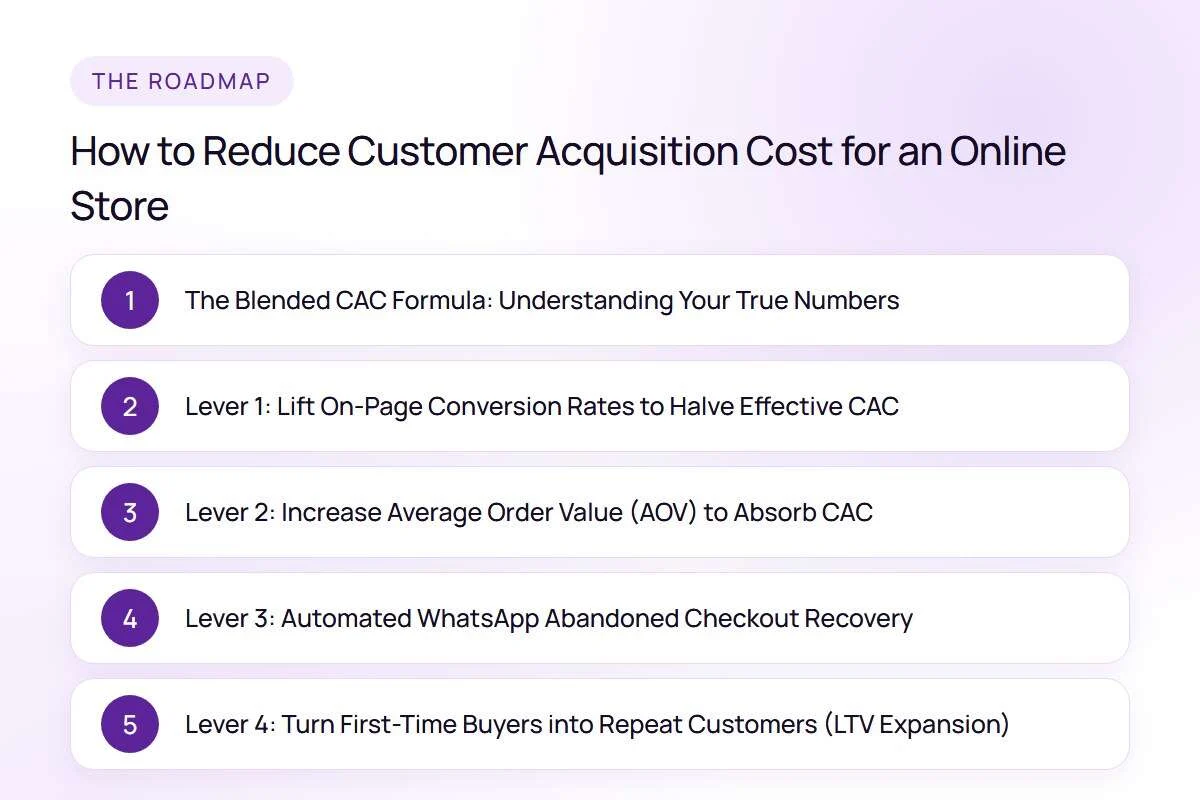
2. Lever 1: Lift On-Page Conversion Rates to Halve Effective CAC
The fastest way to lower your customer acquisition cost is to improve your store's conversion rate. The mathematical relationship between conversion rate and CAC is direct and linear.
Consider this real-world scenario:
- Baseline Store: You spend ₹1,00,000 to drive 20,000 visitors at ₹5 per click. Your store converts at 1.0% (200 orders). Your CAC is ₹500.
- Optimized Store: You spend the exact same ₹1,00,000 for the same 20,000 visitors. By optimizing your mobile product pages, your store converts at 2.0% (400 orders). Your CAC instantly drops to ₹250.
Without spending an extra rupee on ads or begging Meta for cheaper bids, your customer acquisition cost is cut in half simply by eliminating on-page friction.
High-Impact CRO Levers for Indian Stores:
- Accelerate Mobile Page Load Times: Compress all product images to
.WEBPand remove unneeded JavaScript apps. A 1-second improvement in mobile loading speed lifts conversion rates by an average of 7% to 10%. - Transparent COD and Shipping Policies: Clearly state "Cash on Delivery Available" and show an estimated arrival date badge right beside the Buy button.
- One-Click Headless Checkout: Deploy modern fast checkout solutions (such as GoKwik or Shopflo) that pre-fill customer shipping addresses and phone numbers automatically via OTP login.
Review our technical ecommerce website development capabilities to upgrade your store's speed and conversion architecture.
3. Lever 2: Increase Average Order Value (AOV) to Absorb CAC
If paid ad auctions force you to pay ₹500 to acquire a customer, an order value of ₹800 yields a net loss. However, if that same acquired customer checks out with a cart total of ₹2,200, your business generates healthy gross profit.
Increasing your Average Order Value (AOV) effectively dilutes your acquisition expense per rupee earned:
| AOV Enhancement Tactic | How It Works on the Storefront | Expected Impact on Cart Value |
|---|---|---|
| Tiered Free Shipping Bar | Dynamic cart progress bar: "Add ₹350 more to unlock Free Express Shipping!" | +12% to +18% increase in average cart size |
| Quantity Breaks ("Buy More, Save More") | Offer volume tiers on consumables: "Buy 1 for ₹799, Buy 2 for ₹1,399, Buy 3 for ₹1,899" | Drives multi-unit purchases, shifting single orders into bulk packs |
| Pre-Purchase In-Cart Upsells | 1-click add-on items inside the slide-out cart drawer (e.g., matching cleaner, protective case, gift wrap) | 15% to 22% of shoppers accept the low-friction add-on |
| Curated Value Bundles | Package 3 complementary items together at a 15% bundled discount rather than selling individually | Establishes a higher baseline transaction floor across the store |
4. Lever 3: Automated WhatsApp Abandoned Checkout Recovery
In the Indian e-commerce ecosystem, over 70% of shoppers who initiate checkout abandon before completing payment. Leaving these abandoned checkouts unattended is throwing away high-intent traffic you have already paid for.
While traditional email recovery sequences typically achieve modest 15% open rates in India, automated WhatsApp recovery flows achieve open rates exceeding 85% and click-through rates over 30%.
The High-Converting 3-Step WhatsApp Recovery Sequence
Connect an official WhatsApp Business API integration (such as Interakt or Wati) to trigger this automated sequence:
- Message 1 (30 Mins): "Hi [Name], we noticed items left in your cart at [StoreName]! Any checkout issues? Tap here to complete your order: [Cart Link]" (Helpful customer support tone).
- Message 2 (4 Hours): "Hi [Name], items in your cart are in high demand and reserved stock expires shortly. Order today to guarantee delivery by [Day]: [Cart Link]" (Urgency and arrival date).
- Message 3 (24 Hours): "Hi [Name], here is an exclusive 10% voucher code [SAVE10] valid for 2 hours. Tap here to complete your order: [Cart Link]" (Final commercial incentive).
This 3-message sequence routinely recovers 15% to 22% of abandoned checkouts, generating high-margin revenue from traffic you had already paid to acquire.
5. Lever 4: Turn First-Time Buyers into Repeat Customers (LTV Expansion)
The most expensive transaction in e-commerce is the very first purchase. If a customer only buys once, your entire profit is held hostage by your ad spend. True profitability in D2C retail is unlocked on the second and third purchases, where acquisition cost is literally zero.
Implement structured post-purchase retention routines:
- The Unboxing Delight Experience: Include a physical card inside the shipping box featuring a personalized thank-you note and an exclusive QR code offering a discount on their next order within 30 days.
- Automated Replenishment Reminders: For consumable products (skincare, gourmet coffee, nutritional supplements), calculate the exact product lifespan (e.g., 30 days). Trigger an automated SMS/WhatsApp reminder on Day 23: "Running low on your moisturizer? Click here to reorder with 1-click re-stocking."
- VIP Early Access Releases: Reward past customers with 24-hour private access to new product launches before public release.
FAQs
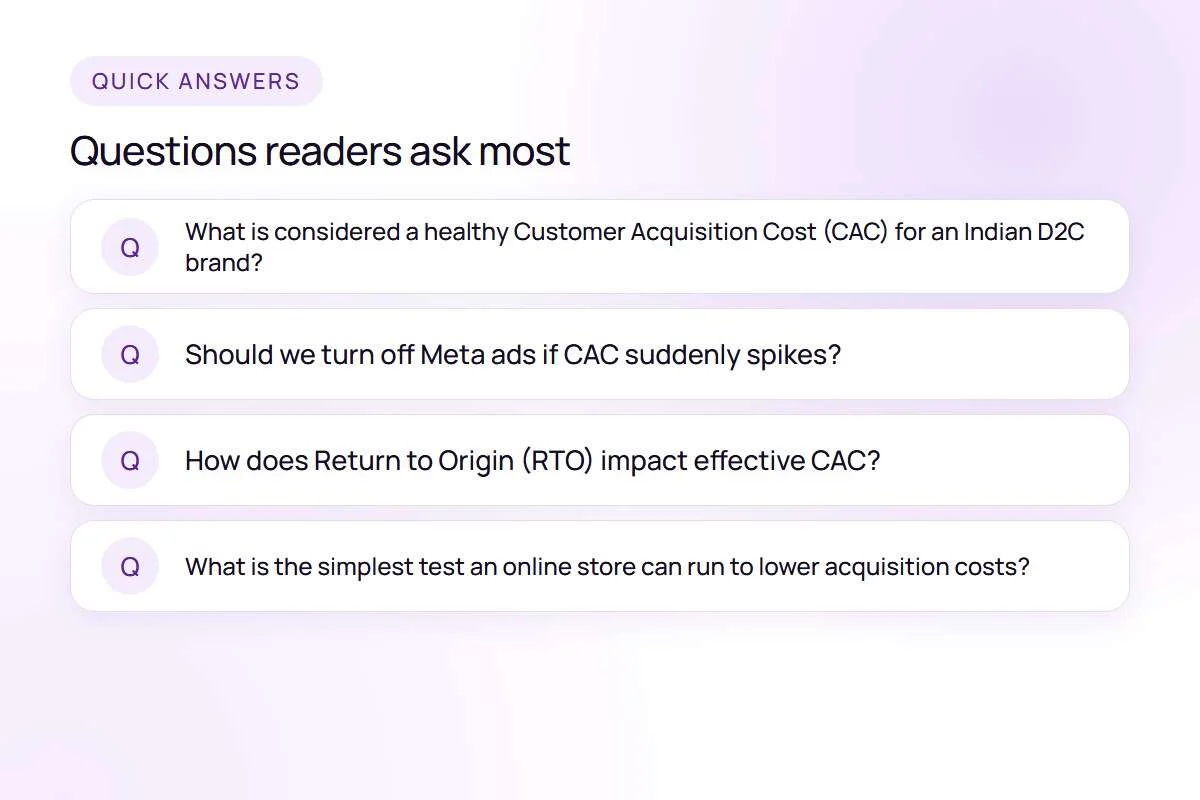
What is considered a healthy Customer Acquisition Cost (CAC) for an Indian D2C brand?
A healthy CAC depends entirely on your product pricing and gross margins. As an operational benchmark, your CAC should not exceed 25% to 30% of your Average Order Value for a first-time purchase. Over a 12-month window, your Customer Lifetime Value (LTV) should be at least 3 times your CAC (LTV:CAC ratio $\ge 3:1$).
Should we turn off Meta ads if CAC suddenly spikes?
Do not turn campaigns off abruptly; that resets the ad platform’s machine learning optimization. First, check your landing page load speeds and checkout funnels for silent technical glitches. Next, refresh your ad creatives with new customer-question hooks and B-roll angles. Fatigue in ad creative is the most common reason for sudden CAC spikes.
How does Return to Origin (RTO) impact effective CAC?
RTO dramatically inflates your true CAC. If 20% of your COD orders are rejected at the doorstep, you paid the full advertising acquisition cost, forward shipping, and reverse courier fees without realizing any revenue. Implementing COD prepayment incentives (e.g., "Extra 5% off on UPI prepayments") and automated address verification via WhatsApp significantly reduces RTO losses.
What is the simplest test an online store can run to lower acquisition costs?
The simplest test is adding an automated one-click upsell inside the cart drawer. Offering a relevant ₹199 to ₹399 add-on item directly increases Average Order Value across 15% of transactions within 24 hours, without requiring any complex development or ad changes.
Next Steps for Your Store's Profitability
Reducing customer acquisition cost is not about hoping for cheaper ad auctions; it is about taking full control of your store's conversion rate, cart size, and customer retention. By optimizing your product pages, increasing order values, and building automated recovery funnels, your business achieves sustainable, profitable growth.
If your e-commerce brand wants to audit its acquisition funnels, deploy high-converting WhatsApp workflows, or scale paid campaigns profitably, explore our e-commerce marketing agency services or contact IPrix Media today for a strategic growth audit.