Website Design Checklist for Jewellery Manufacturers
A complete website design checklist for jewellery manufacturers: B2B wholesale portals, BIS hallmarking trust signals, HD 360-degree media, and RFQ workflows.
By IPrix Media Team, web development and digital marketing company in Udaipur
India’s jewellery manufacturing sector—spanning historic craftsmanship hubs from Surat and Jaipur to Mumbai and Coimbatore—is undergoing a rapid digital transformation.
For decades, jewellery manufacturers relied almost exclusively on trade shows (such as IIJS), offline distributor networks, and physical showroom visits to secure retail partnerships. However, modern jewellery retail chains, international boutique buyers, and online direct-to-consumer (D2C) brands now source manufacturing partners primarily through digital channels.
When a multi-store jewellery retailer or overseas importer evaluates your manufacturing firm online, your website serves as your digital factory floor. If your website resembles an outdated static brochure with blurry photography, missing hallmarking certifications, and broken enquiry forms, international buyers assume your manufacturing precision is equally neglected.
Here is the direct operational rule: A high-converting website for jewellery manufacturers must integrate four core architectural systems—password-protected B2B wholesale catalogues with MOQ tiering, high-resolution 360-degree video asset rendering, prominent regulatory certification architecture (BIS hallmarking, IGI/GIA diamond grading, SEEPZ export credentials), and a streamlined Request for Quotation (RFQ) sample workflow.
This comprehensive checklist guides jewellery manufacturers, export houses, and casting units through building a digital web presence that wins high-ticket domestic and export orders.
1. Wholesale Catalogue Architecture vs Retail E-Commerce
A common mistake jewellery manufacturers make is copying consumer retail websites like Tanishq or CaratLane. B2B jewellery buyers have fundamentally different operational priorities than retail consumers shopping for a wedding ring:
- Retail Consumers Buy on Emotion: Retail shoppers seek aspirational lifestyle storytelling, immediate add-to-cart buttons, and financing options.
- Wholesale Retailers Buy on Margins and Reliability: Commercial retail buyers want to know casting purity standards, metal weight tolerances, labor charges (making charges per gram), production turnaround times, and minimum order quantities (MOQ).
Your website architecture must accommodate these B2B commercial realities through structured catalogue design:
| Architectural Feature | Retail Jewellery Store (B2C) | Jewellery Manufacturing Website (B2B) |
|---|---|---|
| Pricing Display | Public retail pricing including GST and retail markup | Dynamic pricing based on daily bullion rates + making charges |
| Ordering Mechanism | Direct consumer checkout / Payment gateway | Request for Quotation (RFQ) / Custom prototype consultation |
| Catalog Access | 100% open to public search engines | Tiered access: public hero gallery + gated proprietary designs |
| Primary Decision Factor | Design aesthetics, brand prestige, festive discounts | Gram weight consistency, BIS certification, on-time delivery SLA |
| Minimum Order Policy | 1 single unit | Tiered MOQs (e.g., 50 pieces per design, 500g total order) |
For manufacturing brands seeking complete digital acquisition strategies, explore our comprehensive e-commerce marketing agency programs.
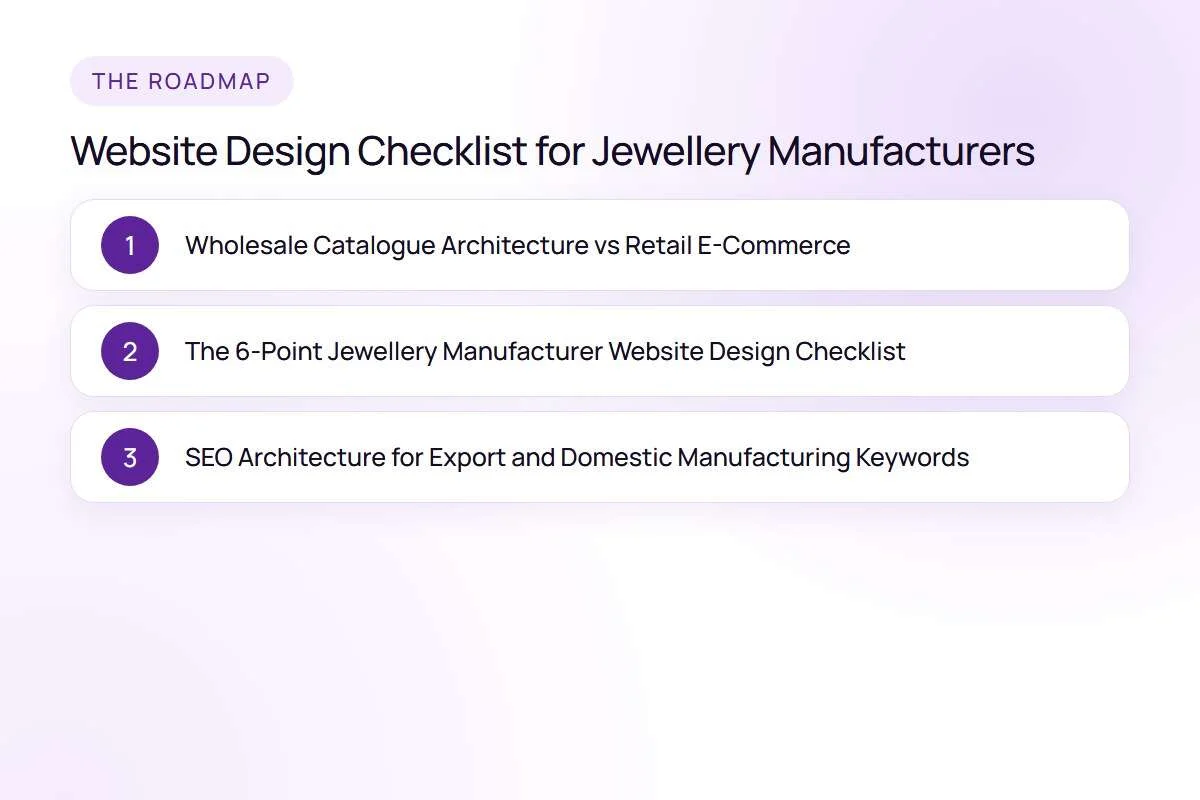
2. The 6-Point Jewellery Manufacturer Website Design Checklist
Run your manufacturing website through this comprehensive diagnostic checklist:
Check 1: Design Protection & Gated Wholesale Portals (Pass/Fail)
Design piracy is the single greatest fear of jewellery manufacturers. If you display exclusive, proprietary CAD collections publicly, competing factories can copy your moulds before your sales team reaches buyers.
- The Design Standard: Implement a two-tier catalogue structure. Display 15 to 20 representative legacy designs publicly to establish craftsmanship capability. Gate your latest trend collections behind a secure wholesale portal that requires buyer business verification (GST registration number, store address, or trade license) before granting login access.
Check 2: Micro-Detail Visual Media and 360-Degree Video Viewers (Pass/Fail)
In fine jewellery, buying decisions hinge on microscopic craftsmanship details: prong setting precision, enamel smoothness, diamond clarity, and clasp durability. Static low-resolution photos cannot satisfy commercial buyers.
- The Design Standard: Provide interactive 360-degree rotation video clips for signature collections. Implement smooth hover-zoom functionality capable of magnifying gemstone pavé settings up to 400% without image pixelation. Ensure media assets are served in compressed
.WEBPand.MP4formats with responsive image srcsets to prevent mobile lag.
Check 3: Regulatory Trust Signals and Certification Transparency (Pass/Fail)
Trust is the ultimate currency in precious metal trading. International buyers and major domestic retailers will not wire five-figure deposits without verified regulatory compliance.
- The Design Standard: Dedicate a prominent section of your global header and footer to official certification badges:
- BIS Hallmark Certification: Display your official Bureau of Indian Standards registration ID.
- Diamond Grading Compliance: Detail partnerships with international gemological laboratories (GIA, IGI, SGL).
- Export Compliance Credentials: For export units, showcase memberships in the Gem & Jewellery Export Promotion Council (GJEPC) and Customs-Trade Partnership Against Terrorism (C-TPAT).
Check 4: The Structured "Request for Quotation" (RFQ) Workflow (Pass/Fail)
Generic "Contact Us" forms with a single open text box generate frustrating, vague inquiries. A B2B jewellery buyer requires structured inputs to communicate their specifications accurately.
- The Design Standard: Deploy a specialized RFQ Lead Funnel with clear parameters:
- Metal purity selection (14K / 18K / 22K Gold, 925 Sterling Silver, Platinum).
- Gemstone preference (Natural Diamonds, CVD/HPHT Lab-Grown Diamonds, Precious Colored Stones).
- Target production volume (Prototyping / 50–200 Units / 500+ Units per month).
- Secure file upload field enabling corporate buyers to attach their private CAD
.STLor.3DMdesign files under non-disclosure agreements (NDA).
Check 5: Factory Infrastructure and Manufacturing Capacity Tour (Pass/Fail)
Corporate retail buyers want proof that you are a genuine manufacturer with scalable machinery, not a middleman trading from a rented laptop.
- The Design Standard: Create a dedicated Infrastructure & Technology page. Feature high-resolution photography and video clips of your actual casting floor: 3D wax printers (EnvisionTEC / Solidscape), German induction casting machines, laser welding stations, and cleanroom quality inspection benches. State monthly production capacity explicitly (e.g., "Monthly manufacturing capacity: 150 kg gold casting and 45,000 diamond-set units").
Check 6: Mobile Responsiveness and Direct WhatsApp Inquiry Routing (Pass/Fail)
Indian retail jewellers and showroom owners conduct massive amounts of business via mobile messaging. When browsing catalogues during showroom hours, they want immediate answers.
- The Design Standard: Implement a sticky, non-intrusive WhatsApp Business integration. When clicked from a specific product catalogue page, the WhatsApp chat should pre-populate with the exact product SKU number (e.g., "Hello, I am interested in receiving wholesale MOQ and pricing for SKU-JWL-4029").
3. SEO Architecture for Export and Domestic Manufacturing Keywords
To generate inbound wholesale inquiries organically, organize your website content into dedicated category landing pages targeting commercial search intent:
- Targeting Domestic Retailers: Build service pages targeting queries like "custom diamond jewellery manufacturer in Mumbai" or "wholesale lightweight 18k gold jewellery casting Surat".
- Targeting Overseas Export Buyers: Target high-intent international search terms like "private label jewellery manufacturer India", "OEM diamond jewellery exporter for US retailers", or "lab grown diamond jewellery manufacturer GJEPC registered".
Pair these dedicated landing pages with detailed technical case studies showing how you solved casting porosity challenges or engineered lightweight luxury designs for international retail brands.
FAQs
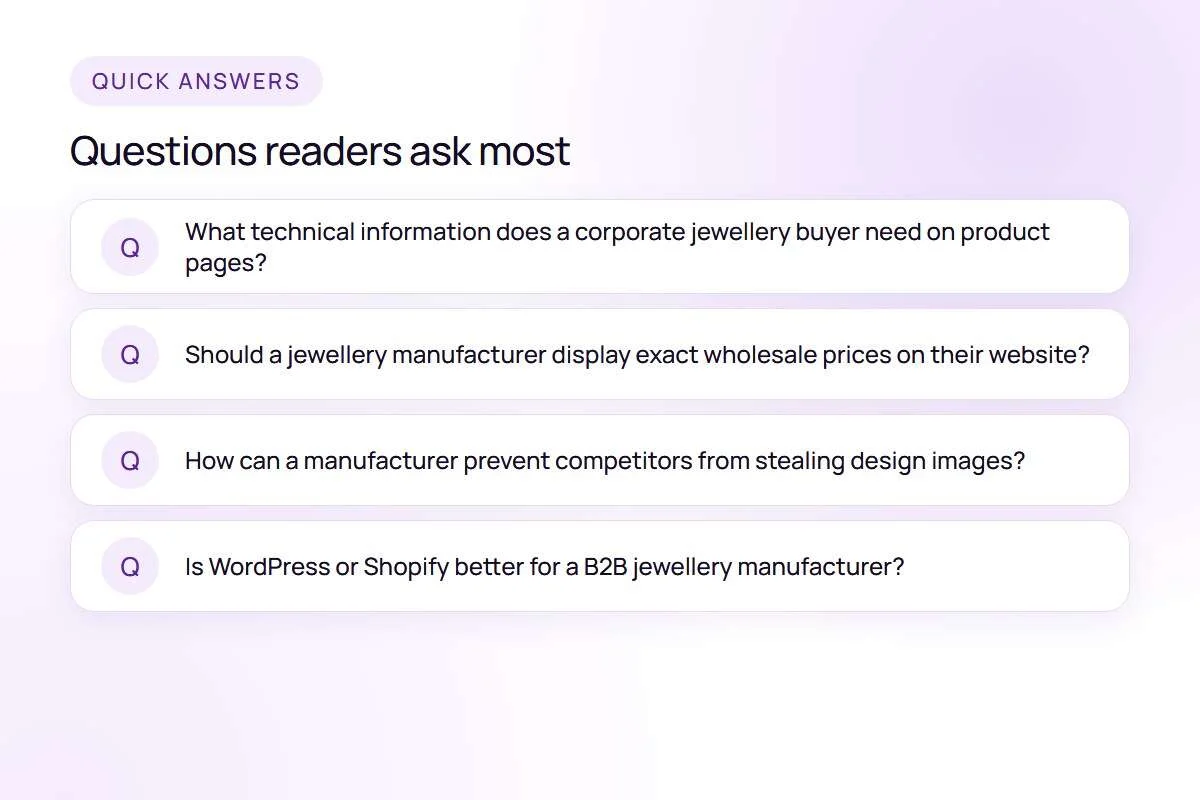
What technical information does a corporate jewellery buyer need on product pages?
A B2B buyer looks for five specific technical specifications: gross metal weight range in grams, net diamond carat weight, average diamond color and clarity grades (e.g., GH-SI1 or EF-VVS), setting type (prong, channel, pavé, bezel), and minimum order quantity per design.
Should a jewellery manufacturer display exact wholesale prices on their website?
Generally, no. Because gold, silver, and platinum spot prices fluctuate daily on commodities exchanges, listing static rupee prices causes confusion. Instead, display transparent making charges per gram (e.g., "Making charges starting from ₹350/gram"), accompanied by an automated currency calculator or direct RFQ button tied to live bullion indices.
How can a manufacturer prevent competitors from stealing design images?
Combine technical and legal protections: disable right-click downloading via JavaScript, watermark all catalogue images with your registered trademark logo, and host high-value collections inside password-protected buyer portals that require verified company credentials to access.
Is WordPress or Shopify better for a B2B jewellery manufacturer?
WordPress with WooCommerce (configured in B2B catalog mode) is typically superior for manufacturers because it allows custom RFQ form logic, gated portal permissions, and multi-currency quoting without high monthly platform transaction fees. Shopify Plus is an excellent alternative for high-volume manufacturers transitioning into hybrid D2C fulfillment.
Next Steps for Your Jewellery Manufacturing Website
A precision-engineered B2B website positions your jewellery manufacturing business as a world-class production partner, opening doors to lucrative retail partnerships and international export contracts.
If your manufacturing firm needs a bespoke B2B catalogue portal, high-converting RFQ funnels, or international digital marketing campaigns, explore our specialized e-commerce marketing agency services or contact IPrix Media today for a strategic manufacturing website consultation.