Jewellery Brand Marketing: How to Match Channels to Product Margins
A practical jewellery brand marketing guide for Indian brands: aligning channels and budgets with product margins across imitation, 925 silver, and fine gold jewellery.
By IPrix Media Team, web development and digital marketing company in Udaipur
The Indian jewellery market is one of the most vibrant, emotionally charged, and financially lucrative retail sectors in the world. From everyday artificial fashion accessories priced at ₹799 to bespoke bridal Polki and certified diamond sets commanding several lakhs of rupees, Indian consumers have an insatiable appetite for fine adornment.
However, marketing jewellery in the digital era is fraught with financial traps. Thousands of jewellery brand owners make the fatal mistake of treating all jewellery products as a single monolithic category. They run identical Meta ad campaigns, deploy the same discount codes, and chase the same broad social media audiences whether they are selling a ₹999 brass ring or a ₹1,50,000 hallmarked gold necklace.
When you fail to align your digital marketing channels and customer acquisition budgets with the exact gross margins and trust requirements of each specific jewellery category, you quickly erode your business profitability. Selling fine diamond jewellery requires deep institutional trust and personal relationship management, whereas selling fast-fashion brass jewellery demands hyper-efficient ad creative velocity and impulse checkout mechanics.
This strategic guide provides Indian jewellery founders and marketing heads with a proven, margin-driven framework to match digital channels to product tiers, protect contribution margins, and build an enduring, profitable jewellery brand.
1. The Three Jewellery Tiers and Their Economic Realities
To build a profitable marketing model, you must segment your jewellery catalogue into three distinct operational tiers, each possessing completely different margin profiles, return-to-origin (RTO) risks, and buyer purchase psychology:
Tier 1: Fashion & Imitation Jewellery (AOV: ₹499 to ₹1,999)
- Product Type: Brass, alloy, zinc, resin, artificial pearls, and trendy daily-wear accessories.
- Gross Margins: Extremely high, typically 65% to 80%. A piece selling for ₹999 often costs under ₹200 to manufacture.
- Buyer Psychology: Low-consideration impulse purchase driven by visual aesthetics, Bollywood fashion trends, and outfit matching.
- Core Marketing Challenge: High Cash on Delivery (COD) refusal rates (RTO losses of 20% to 35%) and fierce marketplace competition from Amazon and Meesho.
Tier 2: Demi-Fine & 925 Sterling Silver (AOV: ₹2,000 to ₹12,000)
- Product Type: Anti-tarnish 925 silver, 18K gold vermeil, laboratory-created gemstones, and contemporary office wear.
- Gross Margins: Moderate to strong, typically 50% to 65%.
- Buyer Psychology: Self-gifting, anniversary gifts, and daily luxury for working professionals seeking lasting quality without fine gold pricing.
- Core Marketing Challenge: Communicating anti-tarnish durability, skin-safe hypoallergenic properties, and packaging presentation.
Tier 3: Fine Jewellery: Gold, Polki, & Natural Diamonds (AOV: ₹25,000 to ₹10,00,000+)
- Product Type: 14K/18K/22K hallmarked gold, certified natural diamonds, bridal uncut Polki, and heirloom heritage sets.
- Gross Margins: Low to moderate percentage, typically 15% to 25% on gold weight plus making charges, and 35% to 50% on diamonds.
- Buyer Psychology: High-consideration investment purchase driven by familial trust, purity guarantees, resale value, and milestone celebrations.
- Core Marketing Challenge: Buyers rarely enter a credit card on a website for ₹2,00,000 without inspecting physical pieces or speaking directly with a senior diamond consultant.
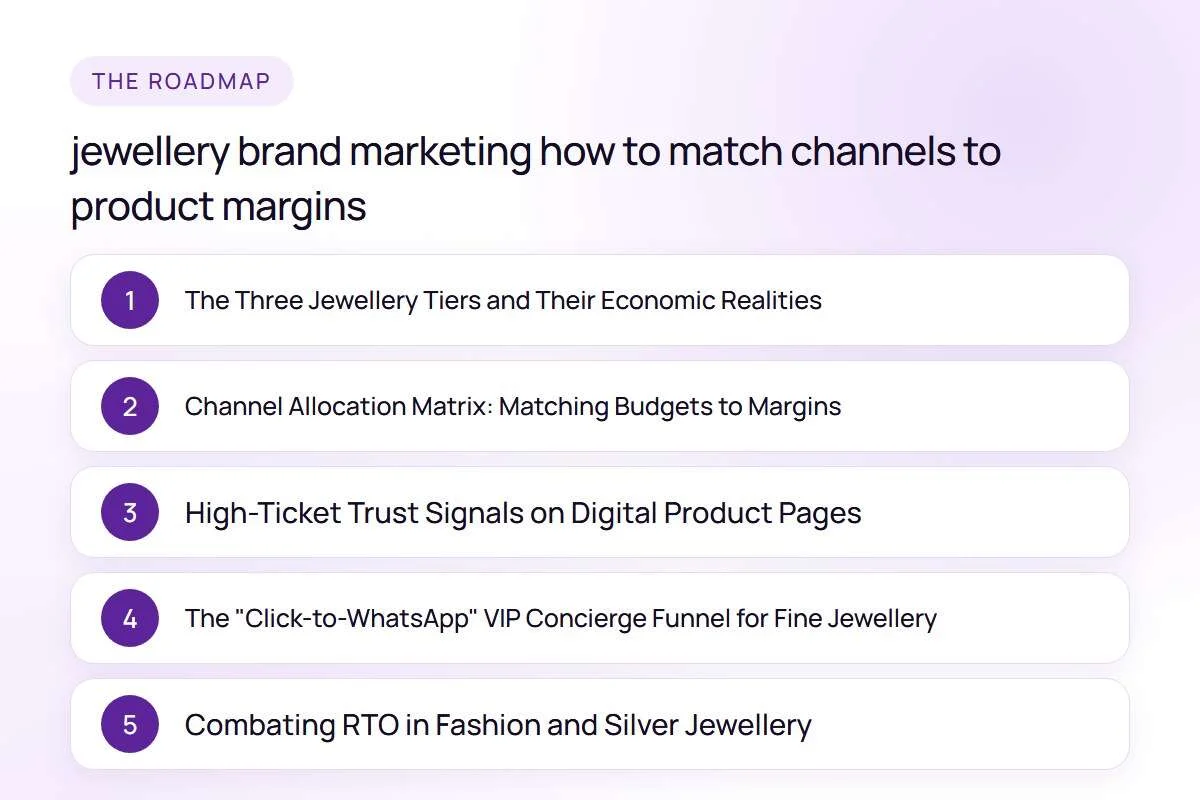
2. Channel Allocation Matrix: Matching Budgets to Margins
Attempting to sell ₹80,000 diamond rings through direct cold Meta traffic with an "Add to Cart" button burns advertising capital. High-ticket items require multi-touch trust-building funnels. Conversely, using expensive personal sales consultants to close ₹799 fashion earrings destroys your operational margin.
Use this strategic channel matrix to allocate your marketing budget appropriately:
| Jewellery Category | Primary Acquisition Channels | Conversion Mechanism | Key Performance Metric |
|---|---|---|---|
| Tier 1: Imitation & Fashion | Instagram Reels ads, Meta Broad Advantage+, Influencer Hauls | Direct one-click online checkout with instant UPI discounts | Net Delivered ROAS (post-RTO deduction); Blended CAC < ₹350 |
| Tier 2: 925 Sterling Silver | Meta Video Ads, Google Shopping (PMax), WhatsApp Retention | Visual gift-packaging unboxing; automated cart recovery | Contribution Margin 1 (CM1); 60-Day Repeat Purchase Rate |
| Tier 3: Fine Gold & Diamond | Google Search (High-intent keywords), Meta Lead Ads, VIP WhatsApp Concierge | Book Private Showroom Visit; 1-on-1 Virtual Video Consultation | Cost Per Qualified Showroom Appointment; In-Store Close Rate |
For jewellery brands seeking multi-channel performance management, explore our dedicated ecommerce marketing agency programs.
3. High-Ticket Trust Signals on Digital Product Pages
When selling Tier 2 and Tier 3 jewellery online, your digital product page must overcome deep consumer scepticism regarding purity and authenticity. In India, trust is non-negotiable when precious metals are involved.
Incorporate these mandatory trust assets on every product page:
- Prominent BIS Hallmarking Verification: Display the official Bureau of Indian Standards (BIS) hallmark logo, including the 6-digit alphanumeric HUID (Hallmark Unique Identification) explanation. Educate consumers on how to verify the hallmark through the official BIS Care app.
- Third-Party Gemmological Certification: For diamond and gemstone pieces, clearly display certification badges from globally respected laboratories such as IGI (International Gemological Institute), GIA (Gemological Institute of America), or SGL. Provide a downloadable sample certificate on the product page.
- Transparent Weight and Purity Breakdown: High-value Indian buyers demand complete transparency. Provide a clear table detailing Net Gold Weight, Gross Weight, Diamond Carat Weight, Diamond Color/Clarity (e.g., GH-SI or VVS-VS), and the exact Making Charge breakdown.
- HD Video Try-On and Scale References: Jewellery photography is notoriously deceiving regarding scale. Feature 10-second video clips showing a real model wearing the piece in natural daylight, alongside reference shots against a collarbone or hand, allowing buyers to gauge exact proportions.
4. The "Click-to-WhatsApp" VIP Concierge Funnel for Fine Jewellery
For fine jewellery brands, the most profitable digital funnel is not a traditional e-commerce cart; it is the Click-to-WhatsApp Concierge Funnel.
Follow this proven high-ticket sales workflow:
- Targeted Discovery Ads: Run Meta and Google ads showcasing bespoke bridal or diamond collections with a call-to-action: "Schedule a Virtual Video Viewing".
- Dedicated WhatsApp Routing: Clicking the ad opens an immediate WhatsApp conversation with a certified jewellery specialist.
- HD Video Consultation: The specialist hosts a 15-minute high-definition video call from the showroom, displaying the exact piece under showroom lighting, demonstrating craftsmanship details, and answering certification questions.
- Custom Quotation & Secure Milestone Payment: The specialist sends a formal GST-compliant invoice with Razorpay/bank transfer details, accompanied by insured courier tracking via specialized carriers (such as Sequel Logistics or BVC Logistics).
This concierge workflow routinely achieves conversion rates exceeding thirty percent from qualified video appointments, generating lakhs of rupees in sales with zero showroom walk-in overhead.
5. Combating RTO in Fashion and Silver Jewellery
For Tier 1 and Tier 2 brands, unmanaged Cash on Delivery returns will destroy your balance sheet. When a ₹1,200 silver parcel is returned by the courier, your business incurs forward and reverse shipping costs of ₹150 to ₹250, wiping out the profit of the next two successful orders.
Enforce these strict RTO mitigation protocols:
- Incentivise Instant UPI Payments: Offer an immediate ₹100 flat discount or 7% off for all prepaid orders paid via UPI at checkout. Getting buyers to pay upfront eliminates RTO risk entirely.
- Mandatory WhatsApp OTP for COD Orders: Trigger an automated WhatsApp message requiring the buyer to click "Confirm Order" before warehouse dispatch. Automatically cancel orders that fail verification within 24 hours.
- Blacklist Chronic RTO PIN Codes: Analyze your courier return history quarterly. Disable COD payment options in postal PIN codes exhibiting return rates above forty percent.
FAQs
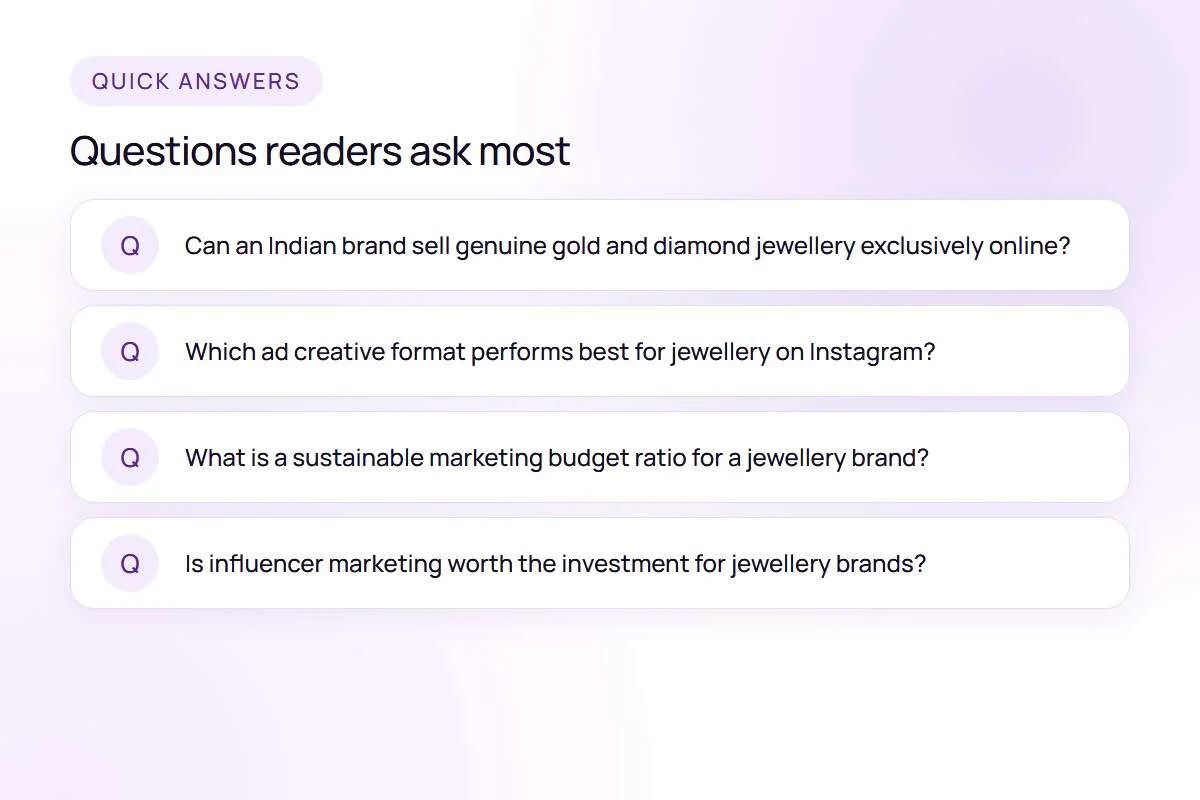
Can an Indian brand sell genuine gold and diamond jewellery exclusively online?
Yes, but the business must provide irrefutable trust proof: BIS hallmarking with verifiable HUID, international laboratory certification (IGI/GIA), insured delivery with tamper-evident packaging, and a transparent 15-day 100% money-back return policy.
Which ad creative format performs best for jewellery on Instagram?
Direct-to-camera unboxing videos and macro close-ups showcasing sparkle under natural light consistently outperform static studio images. Showing a customer wearing the jewellery while explaining its craftsmanship generates higher emotional connection.
What is a sustainable marketing budget ratio for a jewellery brand?
For fashion jewellery with 70% margins, marketing spend typically absorbs 25% to 35% of revenue. For fine gold and diamond jewellery with 20% to 30% gross margins, marketing acquisition costs must be strictly contained between 6% and 12% of total transaction value to ensure operational profitability.
Is influencer marketing worth the investment for jewellery brands?
Micro-influencer gifting (creators with 10k to 50k engaged followers) is highly effective for Tier 1 and Tier 2 fashion and silver brands. Avoid paying massive upfront fees to celebrity mega-influencers unless contractually tied to specific performance milestones and creative usage rights.
Next Steps for Your Jewellery Brand Growth
Thriving in the competitive Indian jewellery market requires aligning your creative storytelling with uncompromising mathematical discipline. By selecting marketing channels that match your specific product margins, deploying bulletproof trust signals, and building personal concierge sales funnels, your jewellery brand can scale profitably while building lasting customer devotion.
If your jewellery brand is looking to scale its direct-to-consumer revenue or build a high-converting digital showroom, explore our specialized ecommerce marketing agency solutions or contact IPrix Media for a strategic consultation today.