Search Intent Explained With Real Business Website Examples
Understand search intent in modern SEO: informational, commercial, transactional, and navigational intent explained with real business website case studies.
By IPrix Media Team, web development and digital marketing company in Udaipur
Traditional SEO once focused solely on keyword matching. If your business wanted to rank for a phrase, an agency placed that exact phrase across headings and body text.
Today, search algorithms prioritize Search Intent—the underlying motivation driving a user's search query. Are they seeking a definition, comparing tools, or ready to hire a service provider?
Serving a sales pitch to someone seeking an educational tutorial causes users to bounce immediately. No volume of backlinks can compensate for a page that fails user intent.
Here is the operational rule: Categorize target keywords into four distinct intent categories—Informational, Commercial Investigation, Transactional, and Navigational. Align each intent category with tailored page architecture: educational blog guides for informational queries, comparative matrices for commercial research, and streamlined landing pages for transactional searches.
This guide analyzes each intent type with real business website examples to help you align content with buyer motivation.
1. The Four Types of Search Intent: The Core Framework
Google’s Search Quality Rater Guidelines divide search queries into four primary stages: Informational (learning concepts), Commercial Investigation (comparing options), Transactional (ready to buy or hire), and Navigational (seeking a specific destination URL).
To capture qualified buyers across every phase of the acquisition funnel, explore our specialized SEO for sales growth frameworks.
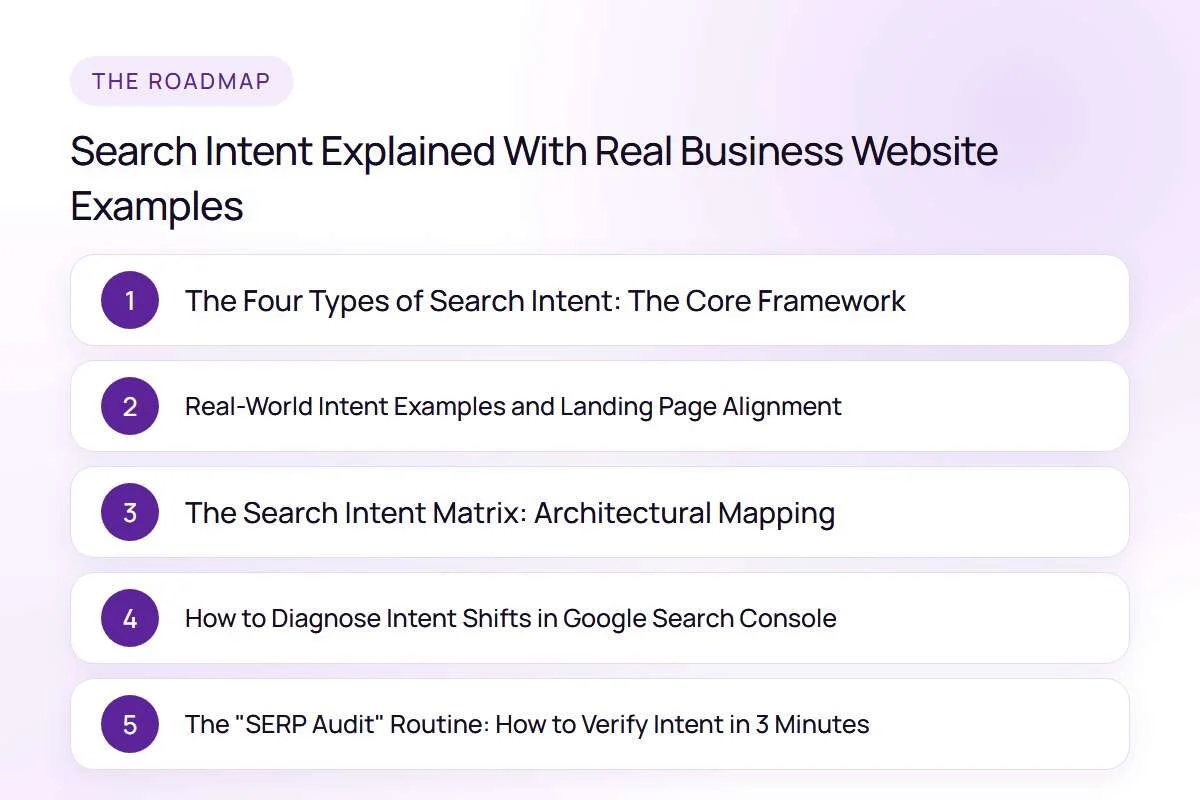
2. Real-World Intent Examples and Landing Page Alignment
Let us examine how each intent type functions in a real commercial business context, highlighting what a winning page looks like versus what a failing page looks like:
Example 1: Informational Intent ("Know" Queries)
- User Query: "What is the difference between cold-rolled and hot-rolled steel?"
- User Motivation: An engineer, architect, or procurement manager is researching material specifications for an upcoming construction project. They want an objective, educational explanation.
- The Winning Page Format: A detailed technical guide featuring comparison diagrams, tensile strength tables, and practical application examples. The call-to-action is low-pressure: downloading a complete steel specification handbook.
- The Failing Mismatch: Directing this user to a "Buy Steel Coils Now / Call for Immediate Quote" transactional checkout page. The user closes the tab immediately because they are not yet ready to order.
Example 2: Commercial Investigation Intent ("Compare" Queries)
- User Query: "Shopify vs WooCommerce for Indian D2C brand"
- User Motivation: An e-commerce founder has already decided to build an online store, but is actively evaluating which technology platform best accommodates Indian payment gateways, shipping logistics, and monthly operational costs.
- The Winning Page Format: A balanced, comprehensive side-by-side comparison table detailing transaction fees, hosting requirements, developer costs, and scalability trade-offs. The page concludes with clear decision rules ("Choose Shopify if… Choose WooCommerce if…").
- The Failing Mismatch: A 200-word promotional article claiming "WooCommerce is the best and everyone should use it because our agency builds WooCommerce sites." Biased, shallow content destroys credibility.
Example 3: Transactional Intent ("Do / Buy" Queries)
- User Query: "Industrial solar panel installation company Ahmedabad"
- User Motivation: A factory owner has committed budget and requires an experienced commercial contractor to design and install a rooftop solar array. They want to verify credentials, view past industrial installations, and request an engineering quote.
- The Winning Page Format: A high-converting commercial service landing page showcasing certified engineering licenses, industrial client case studies (with kW capacities), verified ROI calculators, and a streamlined quote request form.
- The Failing Mismatch: An 800-word philosophical essay titled "The History of Solar Energy in Gujarat." The buyer leaves because they cannot find service packages or contact details.
Example 4: Navigational Intent ("Go" Queries)
- User Query: "Razorpay payment gateway dashboard login"
- User Motivation: An existing merchant wants to access their account to view daily settlements.
- The Winning Page Format: Direct login portal with zero promotional barriers.
- The Strategic Rule: Never attempt to rank for a competitor’s navigational brand query. Search engines will almost always award the top position to the official brand domain.
3. The Search Intent Matrix: Architectural Mapping
Use this operational matrix to audit your website's content assets against user search intent:
| Search Intent Category | Common Keyword Modifiers | User Mindset | Target URL Architecture | Primary KPI |
|---|---|---|---|---|
| Informational | How to, What is, Guide, Tutorial, Examples, Ideas | Seeking knowledge or troubleshooting a problem | /blog/ or /resources/ long-form comprehensive guide |
Page dwell time, scroll depth, newsletter opt-ins |
| Commercial Investigation | Best, Top, Vs, Review, Comparison, Alternatives | Evaluating vendors, software, or methodologies | /solutions/ or comparative evaluation guide |
Secondary CTAs (case study download, webinar sign-up) |
| Transactional | Hire, Agency, Services, Pricing, Quote, Near me | Ready to hire, purchase, or initiate contact | /services/ or dedicated /landing-page/ |
Form submissions, phone inquiries, booked consultations |
| Navigational | [Brand Name], Login, Support, Career portal | Navigating to a known destination | Homepage, login screen, or dedicated utility page | Direct navigational path completion |
Optimizing page load speed ensures visitors stay engaged regardless of intent stage. Explore our website speed optimization frameworks to reduce bounce rates.
4. How to Diagnose Intent Shifts in Google Search Console
Search intent is not static; it evolves as consumer habits change. You can use Google Search Console (GSC) to diagnose when your content is suffering from an intent mismatch:
- High Impressions with Very Low Click-Through Rate (CTR): Your page ranks on page one, but users are not clicking your snippet. This indicates your meta title and description do not match the format users are looking for (e.g., your title promises a theoretical guide when searchers want a practical checklist).
- High Clicks with Abrupt Dwell Time Drop (High Bounce Rate): Users click your link, stay for 8 seconds, and bounce back to Google. This proves that while your headline was enticing, the on-page content failed to answer their core question immediately.
- Keyword Cannibalization across Intent Stages: When both your commercial service page and an informational blog post compete for the same keyword query, Google becomes confused about which URL satisfies user intent, causing both pages to fluctuate erratically between rankings.
5. The "SERP Audit" Routine: How to Verify Intent in 3 Minutes
Before writing a single word of new content, perform a 3-minute SERP Audit:
- Open a private browser window (Incognito) and search for your target keyword.
- Examine the top five organic results:
- Are they long-form blog articles? (Signals Informational Intent)
- Are they curated listicles with numerical ratings? (Signals Commercial Investigation)
- Are they corporate service landing pages with lead capture forms? (Signals Transactional Intent)
- Golden Rule: Never attempt to force a transactional service page to rank for a keyword where Google exclusively ranks 3,000-word informational guides. Match the prevailing SERP format first, then outperform competitors on depth, clarity, and original data.
FAQs
Can a single blog post satisfy both informational and transactional intent?
Rarely. Attempting to make one page do both creates conflicting messaging that confuses both users and search crawlers. Instead, create a dedicated informational blog post to answer educational questions, and place contextual internal links pointing toward your dedicated transactional service page.
What should a business do when search intent changes on an existing ranking page?
If an existing commercial page drops in rankings because Google began favoring informational listicles, do not delete the page. Update the content to match the new intent format (e.g., expand it into an in-depth guide with structured comparison tables) or launch a new informational guide and redirect old authority.
Why does Google sometimes rank comparison sites above direct brand pages?
For commercial investigation queries (like "best ERP software for textile mills"), searchers want impartial third-party comparisons, not a single vendor proclaiming themselves number one. Google recognizes this preference and prioritizes neutral evaluation directories over individual vendor sales pages.
How quickly does fixing search intent improve Google rankings?
When you align a mismatched page with the correct search intent, ranking improvements often become noticeable within 3 to 6 weeks as search bots re-crawl the URL and register positive user interaction signals (longer dwell time and fewer immediate bounces).
Next Steps for Your SEO Growth Strategy
Mastering search intent transforms SEO from a guessing game into a predictable revenue acquisition engine. By delivering exactly what buyers are searching for at each stage of their journey, your website captures attention, builds authority, and converts high-intent traffic into qualified clients.
If your company wants to conduct a search intent audit across its web pages, eliminate keyword cannibalization, or scale organic lead generation, explore our SEO for sales growth services or contact IPrix Media today for an architectural consultation.